Diagnosing Damaged O-Rings
Diagnosing Damaged O-Rings
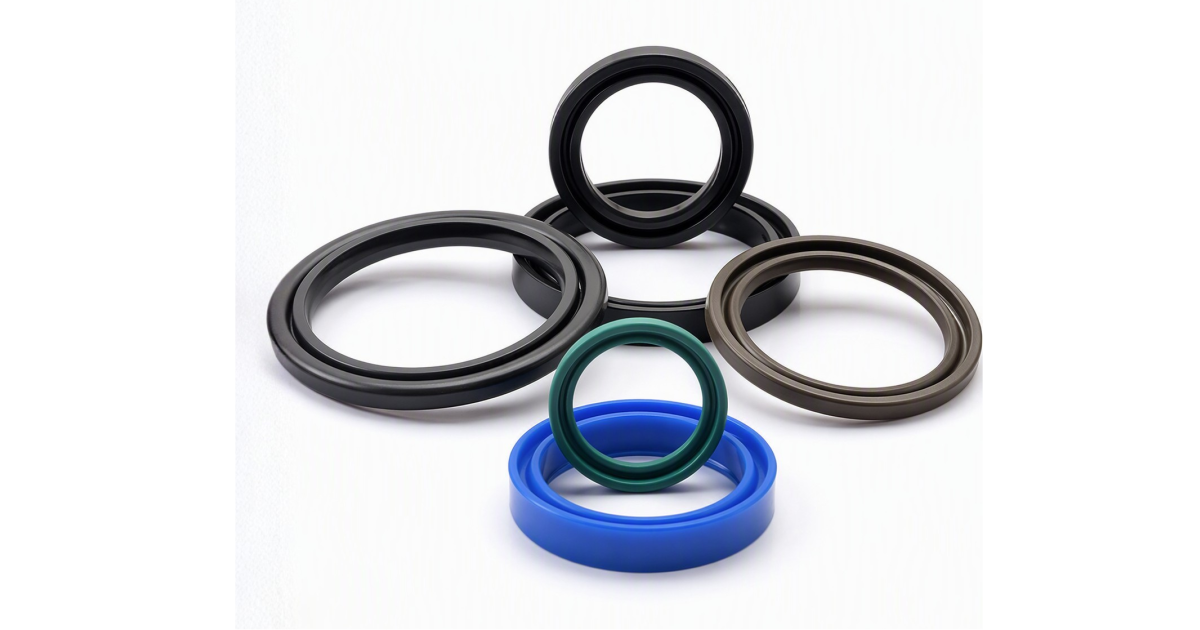
Making sure you have the right O-ring is critical to avoiding leakage in your product or machinery. But if an O-ring fails, do you know how to diagnose the problem? Can you tell the difference between wear and compression set problems in a flattened o-ring? Identifying the right root cause is critical to solving the problem of damaged O-rings. Watch the video below to learn how to diagnose some of the most common o-ring failure modes.
Several o-ring failure modes look the same and identifying the right root cause is critical to solving the problem.
Here are a few lessons learned from some real world applications.
Flattened O-Ring Damage
The most common failure mode is the flattened o-ring.
When a customer sends a picture of a flattened o-ring for diagnosis, they often look for a more compression-set-resistant material.
However, after analysis, somtimes o-rings still look perfectly round. The failure, in this case, was actually a wear problem caused by rough surface finishing. That is the key to telling them apart.
Compression Set in O-Rings
Another common type of o-ring damage is compression set. This causes the o-ring to flatten on both sides, whereas wear causes the o-ring to flatten on one side only. However, you have to take the o-ring out of the groove to be able to see.
O-Ring Extrusion / Chewed-Up O-Rings
Extrusion is an additional common failure mode. Sometimes, customers present chewed-up o-rings but they don't run equipment at high enough pressures to cause it. In these cases, the o-ring was extruding in both directions which told us that they had a gland overfill problem. They simply had too much o-ring in the groove.
Now keep in mind that thermal expansion can cause this especially when dealing with perfluorinated elastomers.
You can also see gland overfill caused by severe chemical swell, but this will also cause the o-ring to get soft and gummy.
Watch the video below for examples of damaged o-rings:
Gallagher Fluid Seals is a Parker Distributor is proud to be proud to be one of the few premier distributors to qualify as a “Parker Seal Technology Center (STC)”.