Attention: When installing GORE Gasket Tape Series 1000 in joints with multiple (2 or more) gaskets compressed with a single set of bolts or clamps, see the installation supplement “Installation on Joints with Multiple Gaskets,” for additional mandatory instructions.
1. Select the size
GASKET WIDTH
Select the gasket width that provides enough material to align the gasket tape flush with the inner and outer diameter. Ensure full coverage of the glass surface. Excess material may exceed the outer diameter.
GASKET THICKNESS
Most applications require a base layer of 6 mm (1/4") tape, which can accommodate deviation up to 1.5 mm (1/16") without shimming. Applications with deviation up to 2.3 mm (0.090") can utilize 9 mm (3/8") tape without shimming.
SHIMMING
To effectively seal flanges with deviations beyond the maximum for the base layer, a shimming process is recommended. Use of 3 mm (1/8") GORE® Series 1000 shim tape as a shim layer will accommodate an additional 1.5 mm ( 1/16") of flange deviation. Ensure the shim layer has the same width as the base layer.
2. Determine a Torque Value
To achieve a reliable seal, adequate gasket stress must be applied during installation.
Typical minimum stress to seal values for GORE Gasket Tape Series 1000 are:
6 mm (1/4"): 14 MPa (2,030 psi)
9 mm (3/8"): 18 MPa (2,610 psi)
Perform an engineering calculation to determine the torque value for your specific application.
Industry guidance is available, for example in ASME PCC-1 Guidelines for Pressure Boundary Bolted Flange Joint Assembly, and EN 1591-1 Flanges and their Joints - Design Rules for Gasketed Circular Flange Connections - Part 1: Calculation.
However, ASME PCC-1 does not include glass-lined steel specialties. Therefore, it is advised to contact the equipment manufacturer for an adequate torque recommendation.
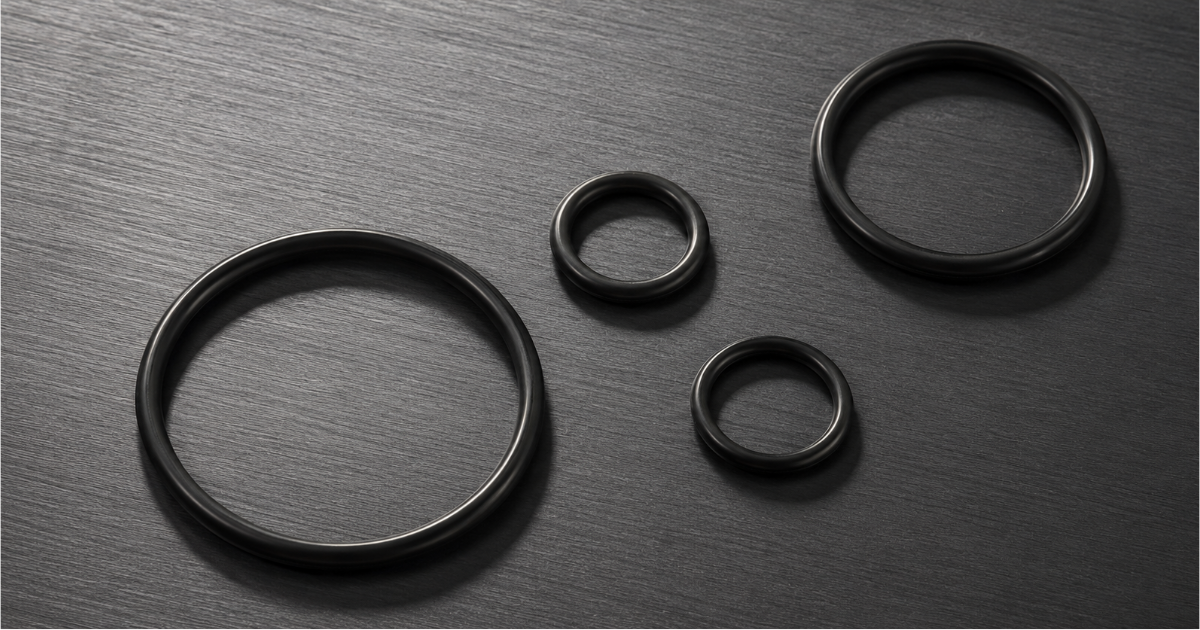
Vulcanized o-rings are manufactured by cutting a specific length of cord stock and joining the ends through a vulcanization process. The way those ends are cut, bevel cut or butt cut, directly affects joint strength, sealing continuity, and long-term performance. Understanding how each cut type behaves under compression and motion helps engineers and technicians select the most reliable option for their sealing application.
Vesconite’s Early Impact on Deep-Mine Pumping in the Free State
In the early 1980s, the Free State goldfields of South Africa were at the height of their productivity, with deep-level mining operations requiring robust, high-capacity equipment to manage water and ensure continuous ore extraction.
At the time, Ray’s Pumps and Service, a Welkom-based company formed 26 years earlier and employing 50 skilled
The optimum function of rotary shaft seals depends on many factors. One of them is the "wettability" of the sealing lip. This parameter plays a particularly important role with synthetic lubricants such as polyglycol. If wetting is too low, not only does wear on the sealing lip increase, but the contact with the rotating shaft can also damage the shaft itself. The engineers at Freudenberg Sealing Technologies (FST) and Freudenberg Technology
Why Spring Energized Seals Are Ideal for Cryogenic LNG Applications
Liquefied natural gas (LNG) systems operate under some of the most extreme conditions in industrial engineering. At temperatures approaching -320°F, conventional sealing technologies quickly reach their limits.
Materials behave very differently at cryogenic temperatures. Elastomers lose elasticity, metals contract,
Thermal Solutions for Tight Semiconductor Cavities
Today’s tech landscape is rapidly evolving, especially in the automotive and communications sectors. Driven by the increased adoption of 5G and 6G as well as advances in data processing, data speeds, and internet connectivity, all sorts of applications from medical devices to EV car batteries are getting faster, more efficient, and more connected.
To keep up with the demand and shifting requirements, manufacturers are now commonly developing
What Really Matters in Manufacturing Cased Metal Lip Seals and Spring-Energized PTFE Seals
High-performance sealing solutions are rarely defined by geometry alone. In demanding environments with high pressure, extreme temperatures, aggressive media, or tight leakage requirements the success of a seal is determined just as much by how it is manufactured as by how it is designed. This is especially true for canned metal lip seals and spring-energized PTFE seals,
Permeation under Control: Sealing Materials for Climate Friendly Substations
Electricity often travels long distances before it reaches consumers. To make this possible, substations rely on sulfur hexafluoride (SF₆), a protective gas used primarily as an insulating and arc extinguishing medium in high and medium voltage electrical systems. If SF₆ escapes as a result of leaks, however, it poses a serious threat to the climate: its global warming potential is around 23,500 times higher than