What Cryogenic Testing Actually Proves (and What It Doesn’t)
Cryogenic testing carries a certain authority. When a component survives exposure to extreme cold, it’s tempting to treat that result as definitive proof of performance in service. Passed the cryo test? Good to go.
In reality, cryogenic testing is far more nuanced. While it can provide critical insight into material behavior and system response at low temperatures, it is often misunderstood, misapplied, or over-interpreted. The gap between “tested at cryogenic temperature” and “proven for cryogenic service” is wider than many realize.
Understanding what cryogenic testing actually demonstrates—and just as importantly, what it does not—can prevent costly assumptions, premature failures, and false confidence during commissioning and operation.
What Cryogenic Testing Is Designed to Reveal
At its core, cryogenic testing answers a narrow but essential question: how does a material or assembly behave when exposed to very low temperatures? This includes temperatures where common engineering assumptions no longer hold.
One of the most valuable insights cryogenic testing provides is how materials respond to thermal contraction. Metals, polymers, and elastomers all shrink at different rates as temperature drops. Cryogenic exposure highlights mismatches in coefficients of thermal expansion that may be invisible at ambient conditions. In assemblies such as valves, seals, or flanged joints, these mismatches can create unexpected gaps, interference, or stress concentrations.
Cryogenic testing also reveals changes in mechanical properties. Many materials become significantly stiffer and more brittle as temperature decreases. Polymers that are flexible at room temperature may transition into a glassy state. Metals can experience reduced toughness, increasing susceptibility to cracking under load or impact. Testing at temperature allows engineers to observe whether components retain sufficient resilience to tolerate handling, vibration, or pressure changes.
For sealing systems in particular, cryogenic testing is often used to verify that contact force is maintained as temperatures drop. Springs, jackets, and gland hardware all respond differently to contraction. A test can confirm whether a seal remains energized, whether leakage occurs during steady-state cold operation, and whether the design concept is fundamentally viable.
When executed correctly, cryogenic testing can also expose immediate design flaws. Gross leakage, catastrophic cracking, loss of preload, or obvious deformation are strong signals that a design is not suitable for the intended temperature range.
These outcomes are real, valuable, and often indispensable. But they represent only part of the story.
What Cryogenic Testing Does Not Prove
Perhaps the most common misconception is that cryogenic testing proves long-term reliability. In most cases, it does not.
Many cryogenic tests are short in duration, involving a single cooldown, a brief hold at temperature, and a warm-up. Passing such a test confirms that the system can survive that specific thermal event. It does not guarantee performance over months or years of service, nor does it account for gradual degradation mechanisms that emerge only with time.
Cryogenic testing also does not fully replicate real operating conditions. Field environments introduce variables that laboratory tests often cannot. Pressure cycling, flow-induced vibration, contamination, transient thermal gradients, and installation variability all influence performance. A component that seals perfectly in a controlled test fixture may behave very differently once installed in a complex system with real tolerances and dynamic loads.

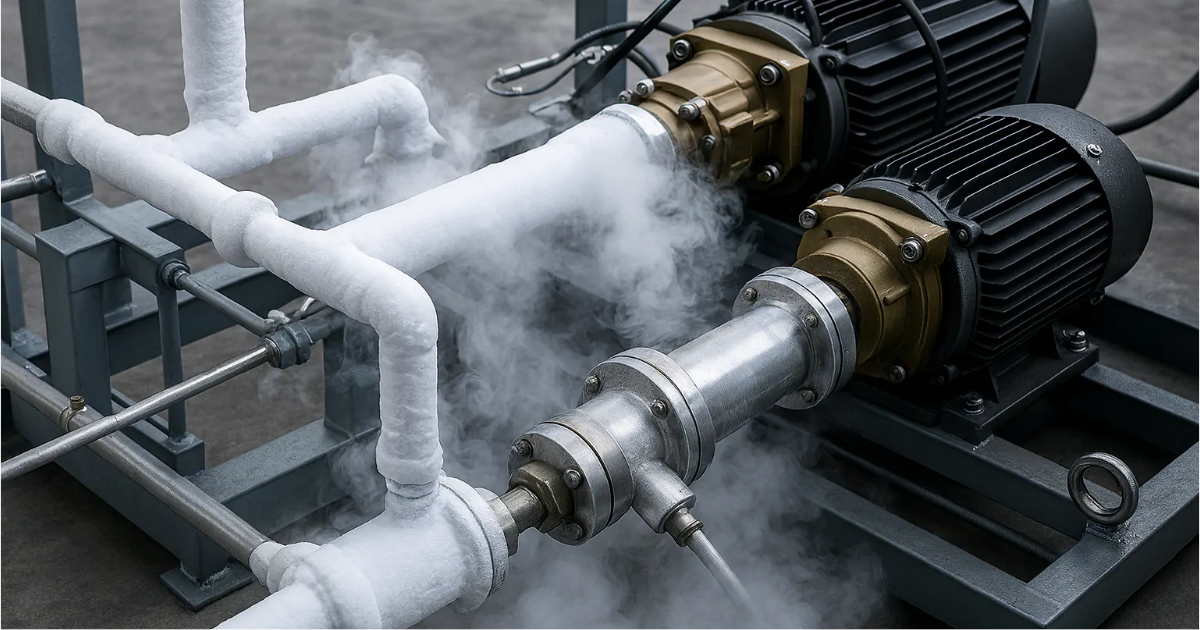
Another critical limitation is that cryogenic testing rarely captures the most failure-prone phase of operation: transitions. Many issues occur not at stable cryogenic temperature, but during cooldown or warm-up. Differential contraction happens rapidly, thermal gradients develop across components, and stresses peak before equilibrium is reached. If a test focuses only on steady-state cold conditions, it may miss the exact moment when leakage or damage is most likely to occur.
Testing also does not inherently validate design margins. A test may show that a component works under a specific set of conditions, but provides little insight into how close it is to failure. Without understanding preload reserve, material property variability, and manufacturing tolerances, it’s impossible to know whether the design is robust or merely fortunate.
Finally, cryogenic testing does not substitute for understanding material science. A successful test result does not change the fundamental behavior of a polymer, metal, or composite. If a material is known to embrittle, creep, or permeate at cryogenic temperatures, no single test overrides those realities. Testing should confirm theory, not replace it.
The Risk of Over-Interpreting Test Results
The danger lies not in cryogenic testing itself, but in how results are interpreted and communicated. A “pass” can become shorthand for universal suitability, even when the test scope was narrow.
This overconfidence can surface during commissioning, when systems experience conditions that were never replicated in testing. It can also appear later, when leaks emerge after multiple thermal cycles or extended dwell times at temperature. In these cases, the failure is often blamed on manufacturing defects or installation error, when the real issue was an assumption gap created during qualification.
In regulated or safety-critical industries, over-reliance on limited cryogenic testing can also complicate root-cause analysis. If a component was previously “qualified,” stakeholders may resist the idea that the design itself is at fault, delaying corrective action.
Using Cryogenic Testing the Right Way
Cryogenic testing is most powerful when treated as one piece of a broader validation strategy. Its role is to confirm behavior, not to serve as a blanket guarantee.
Well-designed test programs start with a clear question. Are you verifying material compatibility, seal energization, leakage rates, or structural integrity? Each objective demands different instrumentation, dwell times, and acceptance criteria. Vague goals produce reassuring but shallow results.
Effective testing also considers transitions, not just endpoints. Monitoring performance during cooldown and warm-up often reveals more than steady-state measurements. In many applications, the first thermal cycle is the most revealing.
Equally important is pairing test data with analysis. Finite element modeling, material property data at temperature, and tolerance stack-ups help explain why a test passed—or why it failed. Together, analysis and testing provide insight into margins and risks that neither approach can deliver alone.
Finally, cryogenic testing should inform design iteration. A pass should lead to questions about repeatability, robustness, and scalability. A failure should be treated as valuable data, not an inconvenience to be worked around.
The Bottom Line
Cryogenic testing is essential, but it is not absolute proof. It demonstrates how a specific design behaves under a specific set of conditions, at a specific moment in time. When engineers understand both the power and the limits of cryogenic testing, they can use it to make better decisions—designing systems that not only survive the cold, but perform reliably throughout their entire operational life.
At Gallagher Fluid Seals, our team of expert engineers is available to help evaluate cryogenic designs, interpret test results, and identify where additional margin or validation may be required. If you are seeking expert guidance on seal selection, material behavior, or qualification strategies for cryogenic service, we welcome the opportunity to support your application from concept through commissioning. Reach out to us today to get started.