Oil & Gas
-
February 05, 2026
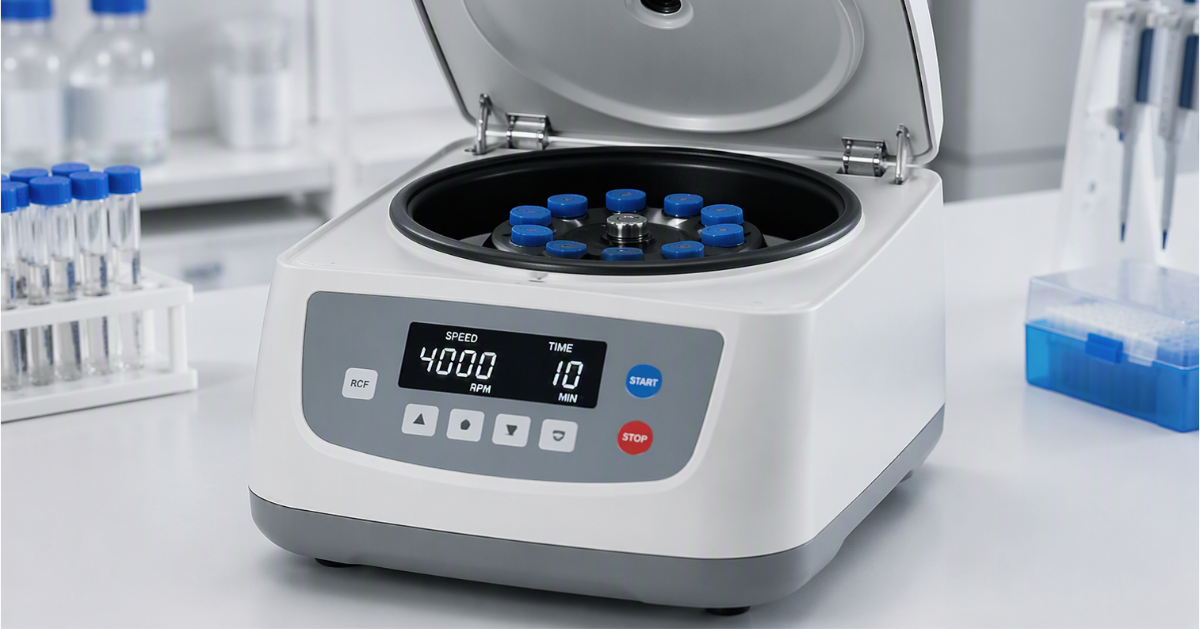
What Cryogenic Testing Actually Proves (and What It Doesn’t)
Cryogenic testing carries a certain authority. When a component survives exposure to extreme cold, it’s tempting to treat that result as definitive proof of performance in service. Passed the cryo test? Good to go.
In reality, cryogenic testing is far more nuanced. While it can provide critical insight into material behavior and system response at low temperatures,
-
January 24, 2025
Style 9000-ESVP from Garlock Helps Refinery Ensure Emissions Compliance
Industry
Oil and Gas
-
June 20, 2024
Gallagher Fluid Seals is a Parker Distributor and is proud to be one of the few premier distributors to qualify as a “Parker Seal Technology Center (STC)”.
The emergence of degradable and dissolvable materials is providing oilfield service companies an opportunity to increase efficiencies and cut costs in the oilfield by simplifying well completions. These materials replace their conventional metallic and polymeric counterparts in completion tools, but eventually break
-
August 03, 2022
DuPont™ Kalrez® 7375, is an innovative FFKM oil-seal product exhibiting broad chemical and water/steam resistance properties required at high temperatures in chemical process industry applications. Kalrez 7375 parts present excellent compression set resistance, exceptional physical property retention,
-
April 23, 2019
Article re-posted with permission from Parker Hannifin Sealing & Shielding Team.
Original content can be found on Parker’s Website.
Oil & Gas Sealing Solutions with a Low Temperature FFKM
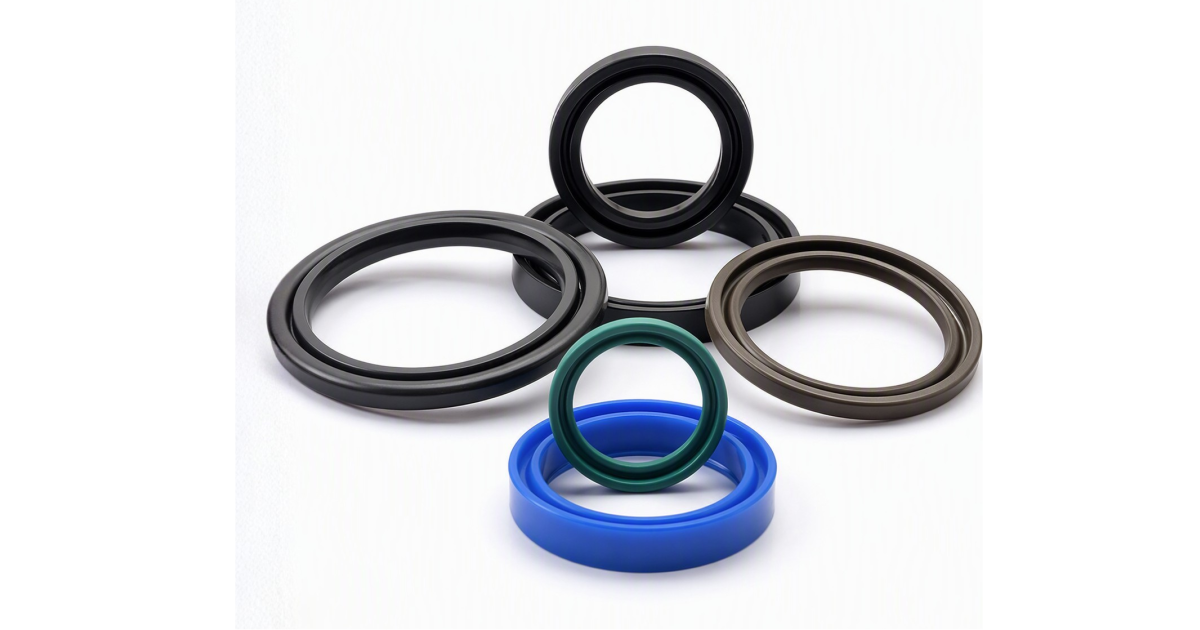
Technology advancements and new-to-world discoveries are constantly creating a new series of challenges for seal materials in the Oil and Gas industry. In today’s environments, seals are being pushed to perform in temperature, pressure and chemical extremes never before thought to be obtainable with rubber products. Application pressures exceeding 20,000 psi, service temperatures ranging from -40°F to upwards of 500°F, and exposure to some of the most aggressive media on the planet are placing immense amounts of stress on sealing elements. Parker’s FF400-80 compound has been formulated to provide a solution to all of these sealing challenges.
FF400-80 Compound - FFKM Product Features
- Temperature range: -40° to 527°F
- Best-in-Class low-temperature FFKM
- Excellent compression set resistance
- RGD resistant per ISO 23936-2 and TOTAL GS EP PVV 142
- Sour service H2S resistant per ISO 23936-2
- Maintained resilience at high pressures and low temperatures
- Great for use in HTHP applications
Sounds great, but what's the catch?
-
July 24, 2018
FFKMs, also known as perfluoroelastomers, were first developed in the 1960s for applications involving high temperatures and/or aggressive chemicals. Perfluoroelastomers exhibit many properties similar to PTFE (polytetrafluoroethlyene, or Teflon®), and are considered inert in almost all solvents. However, PTFE is a plastic, and when compressed, it will not recover to its original shape. On the other hand, elastomers contain crosslinks, which act as springs to give the material resiliency and the ability to recover after a part has been compressed - this resistance to permanent compression gives the material the ability to maintain a seal over time. (To learn more about perfluoroelastomers, download our Introduction to Perfluoroelastomers White Paper).
The article below was recently published on FlowControlNetwork.com, and discusses how FFKMs are being used in oil & gas exploration, as production companies are increasingly operating in high-pressure, high-temperature (HPHT) downhole conditions.
HOW FFKMS PROTECT COMPONENTS IN ENHANCED OIL RECOVERY OPERATIONS
Companies are increasingly operating in high-pressure, high-temperature downhole conditions.
Enhanced oil recovery uses gas, steam or chemical injection to improve flow rate. All graphics courtesy of AGC Improving technologies and methods to increase the recovery of oil from existing reservoirs is a global challenge. In the U.S., oil production at reservoirs can include three phases: primary, secondary and tertiary (or enhanced) recovery. The U.S. Department of Energy (DOE) estimates that primary recovery methods — which rely on the natural pressure of the reservoir or gravity to drive oil into the wellbore, combined with pumps to bring the oil to the surface — typically tap only 10 percent of a reservoir’s oil. Furthermore, secondary efforts to extend a field’s productive life — generally by injecting water or gas to displace oil and drive it to a production wellbore — still only push recovery totals to between 20 and 40 percent of the original oil in place. Clearly, much untapped oil and gas remains in existing wells.