Why is Outgassing Critical in Optics and Electronics Applications?
Article re-posted with permission from Parker Hannifin Sealing & Shielding Team.
Original content can be found on Parker’s Website and was written by Dorothy Kern, applications engineering manager, Parker O-Ring & Engineered Seals Division.
Outgassing is usually most relevant in vacuum applications, where the vacuum causes the elastomer to release constituent material. The constituent material could include water vapor, plasticizers, oils, byproducts of the cure reaction, or other additives used in the seal material. Outgassing becomes a problem if a thin film of those chemicals condenses and is deposited on nearby surfaces. Such a film poses major challenges in highly sensitive applications, such as optics or electronics, where cleanliness is of utmost importance. A seal material with low outgassing is essential because it shows the seal material does not emit volatile constituents under vacuum conditions.
Weight loss of compounds in vacuum
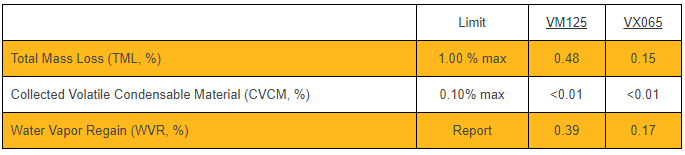
Outgassing is most often characterized by weight loss of the seal material. The ASTM test method E595 is one way to quantify outgassing by measuring Total Mass Loss (TML %), Collected Volatile Condensable Materials (CVCM %) and a reported value for Water Vapor Regain (WVR %). Measurements are taken following a 24 hour exposure to vacuum of 5x10⁻⁵ torr at a temperature of 257°F.
To illustrate, we can look at the most recent outgassing data completed on a few popular low temperature fluorocarbon materials. Table 1 contains the results from a 3rd party laboratory to measure the outgassing properties of VM125-75 and VX065-75. Both had undetectable amounts of CVCM and very small differences between TML and WVR. VX065-75 in particular displayed remarkably little outgassing as well as a low WVR.
There are a few additional resources detailing seal materials that are known for having low weight loss. The O-Ring Handbook ORD 5700, Table 3-19 (page 65 of the pdf), has a few legacy materials with weight loss percent after a two-week exposure to 1 x 10⁻⁶ torr vacuum level, at room temperature. Additionally, non-Parker resources such as the NASA website contain an interesting summary of a much broader range of materials.
For more information about outgassing or electronics applications, contact the Gallagher Fluid Seals engineering department.