Understanding the Lubrication Film in Mechanical Seals
Understanding the Lubrication Film in Mechanical Seals
When mechanical seals fail, the root cause is often attributed to materials, hardware or installation issues. While those factors matter, they are rarely the fundamental reason a seal succeeds or fails in service. In most applications, performance is governed by a microscopic lubrication film that exists between the seal faces during operation.
At its core, a mechanical seal allows two flat faces, one rotating with the shaft and one stationary in the housing, to operate extremely close to each other under pressure. These faces are not intended to run in dry contact. Instead, a very thin fluid film develops between them as the shaft rotates. This film governs friction, heat generation, wear and leakage, enabling continuous operation while allowing relative motion between two solid surfaces.
When this lubrication film becomes unstable or collapses, the consequences extend well beyond the seal itself. From the end user’s perspective, failure often results in unplanned maintenance, lost availability and elevated safety or environmental risk. Although rarely visible or directly measured, the condition of this lubrication film determines the outcome of nearly every mechanical seal application. Understanding how the film functions, how it behaves under real operating conditions and how easily it can be disrupted is essential to achieving mechanical seal reliability.
Functions of the Lubrication Film
The lubrication film performs three critical functions simultaneously.
First, it provides lubrication. By separating the seal faces at the microscopic level, the fluid film reduces direct asperity-to-asperity contact and lowers friction compared to dry sliding. Even minimal separation is sufficient to limit wear and reduce heat generation, helping the faces maintain flatness and stable contact conditions over time. In practice, seal faces are not perfectly separated at all times, but a thin lubrication film significantly reduces the severity of intermittent contact. When the film collapses, friction rises sharply, accelerating wear and initiating surface damage.
Second, the film acts as a heat transfer medium. Friction generated by fluid shearing and intermittent contact produces thermal energy at the seal interface. The lubrication film absorbs this heat and transports it into the surrounding fluid, preventing excessive temperature rise at the faces. Because heat dissipation through the solid faces or to the atmosphere is limited, this fluid-mediated cooling is critical. If the lubrication film is disrupted by vapor formation or dry running, this cooling pathway is lost and interface temperatures can rise rapidly, exceeding material thermal limits and causing distortion, cracking or fracture.
Finally, the lubrication film creates the seal itself. Leakage is restricted by the extremely small gap between the faces, which generates strong viscous resistance to fluid flow. Because this resistance increases rapidly as the gap decreases, microscopic changes in film thickness can produce large changes in leakage. As a result, the film must remain thick enough to lubricate and cool the faces while still being thin enough to limit fluid escape.
Balancing Wear & Leakage at the Seal Interface
Long-term seal reliability depends on maintaining a narrow balance between wear control and leakage control. The lubrication film must protect the faces while simultaneously restricting flow. If this balance shifts too far in either direction, the seal rapidly moves toward failure.
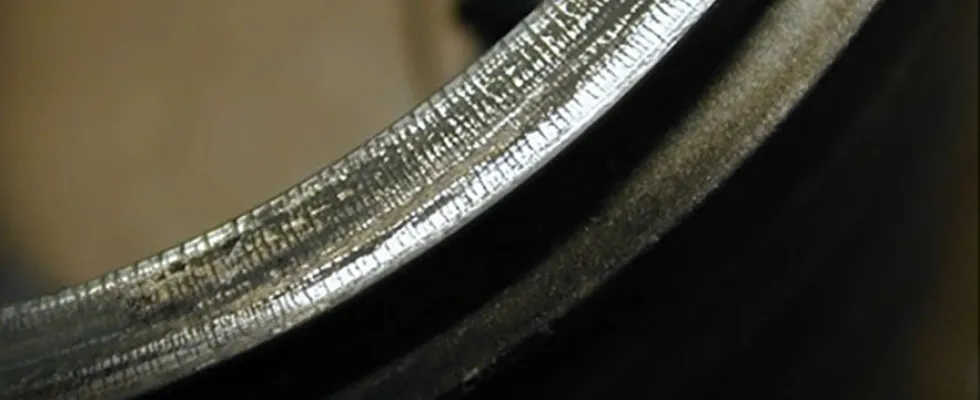
If the film becomes too thin, friction increases sharply, and localized heating develops at the interface. This heating is rarely uniform. Temperature gradients can form across a single face, and differences in thermal response between mating rings can amplify distortion. Even slight warping or coning disrupts stable film formation and concentrates contact stresses. Over time, localized damage, microcracking and surface degradation accelerate wear, leading to grooves, unstable leakage, loss of flatness and eventual failure.
If the film becomes too thick, the seal’s primary function is compromised. A larger gap allows pressure-driven flow through the interface, increasing leakage or emissions. At the same time, an overly thick film reduces stiffness at the seal interface, allowing the faces to move or tilt under normal operating disturbances. This loss of stiffness makes it more difficult to maintain uniform load distribution and stable alignment, increasing leakage sensitivity even under otherwise acceptable conditions.
Understanding Lubrication Regimes
Seal behavior is often described using lubrication regimes commonly illustrated by the Stribeck curve. While the underlying mathematics are complex, the concept is straightforward. Friction and wear depend on how thick the fluid film is relative to surface roughness.

Mechanical seals transition between boundary, mixed and hydrodynamic lubrication regimes as operating conditions such as speed, load and fluid properties change. Boundary lubrication occurs when the film is too thin to fully separate the faces and surface contact carries most of the load. This condition commonly arises during startup and shutdown, or when sealing low-viscosity or poorly lubricating fluids. In this regime, seal performance depends heavily on material properties, making the interface highly vulnerable during transient events.
Mixed lubrication represents the preferred operating condition for most liquid seals. A thin fluid film carries most of the load while limited, controlled contact still occurs. This balance provides sufficient lubrication and cooling while keeping leakage within acceptable limits.
Hydrodynamic lubrication occurs when the faces are fully separated by the fluid film, eliminating direct contact and wear. While this condition minimizes surface damage, it can lead to increased leakage unless the seal is specifically designed to manage it. This regime is intentionally used in dry gas seals, where engineered face geometry generates a stable gas film during normal operation.
Dry running represents a complete loss of the lubrication film and is not sustainable. Without lubrication or cooling, interface temperatures rise rapidly, often leading to thermal shock, face fracture or elastomer failure. Once dry running begins, recovery is rare even if fluid is restored.
Factors Influencing Lubrication Film Formation
The ability to maintain a stable lubrication film depends on several interacting variables related to the fluid and operating conditions. These variables continuously change during real pump operation, causing the lubrication regime to shift toward or away from stability.
Fluid viscosity is the dominant contributor to film formation. Higher-viscosity fluids form thicker, more stable films and resist being squeezed out of the interface. Low-viscosity fluids such as hot water, light hydrocarbons or supercritical carbon dioxide (CO2) provide little inherent film strength, making stable lubrication difficult to maintain. This is why sealing propane is fundamentally more challenging than sealing heavier oil-based fluids.
Pressure increases the closing force on the seal faces, requiring the lubrication film to generate sufficient lift to maintain separation. Shaft speed plays a complementary role by helping generate hydrodynamic lift. As rotational speed increases, viscous drag pulls fluid into the extremely small gap between the faces. Flow restriction within this gap causes pressure to build in the film, which helps support partial separation. At low speeds, this effect diminishes, increasing the likelihood of direct contact.
Temperature is often the most destabilizing influence. As temperature rises, viscosity decreases, weakening the lubrication film and reducing its ability to resist closing pressure. At the same time, vapor pressure increases, making the film susceptible to flashing. If the interface approaches the fluid’s boiling point, the liquid film can vaporize, displacing the liquid and eliminating both lubrication and cooling.
Additional factors impacting lubrication include surface roughness and flatness, seal balance, face geometry, axial compliance, shaft runout, misalignment and the presence of contaminants or entrained gas.
Common Operational Challenges
Real-world pump operation rarely provides ideal conditions for lubrication stability. While seals are often designed around steady-state assumptions, actual operating environments are dynamic. Many failures originate not from design flaws, but from operating conditions that push the lubrication film outside its narrow stable range.
High pressure combined with low viscosity is particularly challenging. Pressure increases face loading while low-viscosity fluids offer little resistance to squeeze-out. Elevated temperature further weakens the film, often forcing the seal into boundary lubrication even during normal operation.
Transient events pose an equally serious threat. During startup, shaft speed may be too low to establish separation while pressure is already applied. During shutdown, speed decays while residual pressure remains. Repeated contact during these events causes cumulative damage that shortens seal life, and in some cases, a single severe transient is sufficient to initiate failure. This sensitivity is especially pronounced in dry gas seals, where no liquid film exists at low speed.
Sudden process upsets such as pressure spikes and flashing further destabilize the lubrication film. Pressure spikes abruptly change face loading, while marginal flashing conditions allow frictional heat to vaporize the interface fluid. Once the film flashes into vapor, lubrication and cooling are lost and failure typically follows quickly.
From Passive Geometry to Engineered Film Control
For decades, the industry relied on precision flatness and geometric balance to manage lubrication behavior. These passive approaches enabled reliable operation under stable conditions, but they depend heavily on favorable operating environments. As applications push toward lower-viscosity fluids, higher pressures, stricter emission limits and more frequent transients, the limitations of flat-face designs become unavoidable.
This article was originally written by Hwan Ryul Jo for Pumps & Systems.