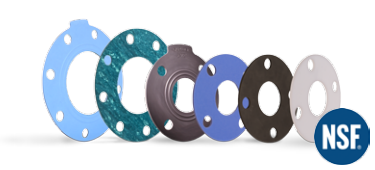
gasket
-
February 28, 2020
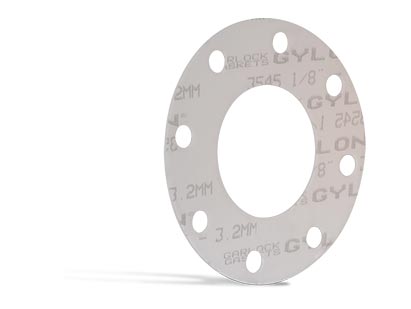
GYLON EPIX® is a family of gaskets that effectively seals a broader range of applications and is more forgiving during the installation process. It allows the end user to save valuable turn-around time, reduce re-work, and lower costs, helping them to finish ahead of schedule and under budget.
GYLON EPIX® features a hexagonal surface profile that provides the torque retention and blowout resistance of a thin gasket and the conformability of a thicker gasket. GYLON EPIX Style 3504 is a high performance, aluminosilicate microsphere filled PTFE sheet material designed for use in moderate concentrations of acids, and caustics, as well as hydrocarbons,
-
January 08, 2020
Bacteria accumulation can ruin product and put consumer health at risk.
Bacteria accumulation is a serious issue in the food manufacturing industry - it can ruin product and put consumer health at risk.
While many know that Polytetrafluoroethylene (PTFE) is an excellent choice for use in diaphragms and gaskets, most do not realize that there exist varying grades of PTFE. Some lower cost PTFE offerings may contain an excessive volume of pores within their structure which can harbor organic contaminants such as bacteria.
To address this problem, a calendared manufacturing process is used. Calendared PTFE is a premium grade PTFE designed for use in aseptic applications requiring ultra-high purity standards. It is ideal for use in food, pharmaceuticals and a variety of clean markets.
Molded Diaphragm made from calendared PTFE Distinguished by an extremely low void content, calendared PTFE resists permeation and the accumulation of foreign matter, reducing the risk of harboring unwanted bacteria or residual media.
To achieve this, the unique manufacturing process orients the chains of PTFE in a lattice-like structure that reduces voids in the material and provides it with biaxial strength. This unique structure also delivers a very high flex life. When tested in an MIT Folding Endurance Tester, the flex life of calendared PTFE is four-times greater than conventional PTFE materials.
Unlike the skived process that is commonly used for PTFE manufacturing, the calendaring process produces uniform sheets of material with consistent physical properties. This gives calendared PTFE a renowned reputation for predictable performance and quality. The opposite is true for skived PTFE where variable properties lead to varying performance and reliability.
-
December 13, 2019
Gylon Epix's patterned material provides enhanced compressibility for better sealing
Gaskets are ubiquitous components in a processing plant. Every flange, equipment joint and connection point will have some form of gasket to prevent fluids from compromising (i.e., leaking from) a process system. However, effective sealing can pose challenges. A new form of polytetrafluoroethylene (PTFE) gasket, Gylon Epix, already has successfully addressed a number of persistent problems at plants.
-
December 05, 2019
Article re-posted with permission from Parker Hannifin Sealing & Shielding Team.
Original content can be found on Parker’s Website and was written by Ben Nudelman, Market Development Engineer, Chomerics Division.
Form-in-place EMI gaskets, also known as FIP EMI gaskets, is
-
October 29, 2019
Better and faster access to the seals you need to keep your production running.
King of Prussia, PA. October 29, 2019 /News and Updates/ -- Gallagher Fluid Seals (GFS) is excited to announce the launch of its e-commerce store, providing a brand new experience to shop for seals.
“It’s been a complete team effort,” says Chris Gallagher, CEO. “Our team has worked diligently over the past several months to prepare and deliver a state-of-the art e-commerce store
-
September 10, 2019
The search for the ideal Polytetrafluoroethylene (PTFE) gasket has been elusive. Competing applications and workplace variables have led to the creation of myriad solutions, yet none that has proven fully adaptable and appropriate for universal adoption.
Garlock Sealing Technologies considered this to be a critical yet entirely solvable shortcoming. And it is against this backdrop that in 2016, they set out to compile a comprehensive list of attributes for the ideal PTFE gasket — a wish list, as it were — in order to build a better gasket.
Working with a third-party survey development company, Garlock developed an exhaustive questionnaire that probed every aspect and functionality of PTFE gaskets, testing and adjusting the questions until they had a workable, finalized version.
Using this final questionnaire, Garlock conducted extensive interviews at 15 major chemical processor companies, speaking with 20 engineers responsible for process operations, projects, maintenance and reliability. The goal was simple: to discover the ideal characteristics and their relative importance that engineers sought in a PTFE gasket.
After several months of data collection, Garlock analyzed the feedback and noted the most popular responses:
- 28% of respondents said that they struggled with how different gaskets required different compressive loads and how to ensure that those gaskets had been installed properly
- 21% expressed frustration with the creep properties of PTFE gaskets
- 21% desired a gasket that seals with less compressive load
- 14% expressed frustration at the installation inconsistencies of their fitters
- 14% expressed frustration with leaking, especially after a successful installation and start-up
From those answers, Garlock drew the following conclusions, representing the most desirable and essential PTFE gasket characteristics:
- Seal: Seals easily
- Installation and assembly: Forgiving of poor installation or assembly practices
- Forgiving: Forgiving of poor flange conditions
- Retention: Maintains a seal after installation
- Flexible: Can be used in a broad range of services to avoid user confusion and reduce inventory
Introducing: GYLON EPIX
Garlock used this feedback in developing a next generation PTFE gasket — GYLON EPIX. Featuring a hexagonal surface profile, GYLON EPIX offers superior compressibility and sealing for use in chemical processing environments. Its enhanced surface profile performs as well or better than existing 1/16″ or 1/8″ gaskets, allowing end-users and distributors to consolidate inventory, lower the risk of using incorrect gasket thicknesses and reduce stocking costs.
GYLON EPIX checks off the most desirable gasket attributes:
- Installation and assembly: Even distribution of the bolt load over the contacted area of the gasket during the assembly process
- Retention: Retention of the bolt load administered at assembly
- Seal: Efficient translation of bolt load to sealing performance
- Forgiving: The ability to perform in imperfect flanges and installation conditions
GYLON EPIX with its raised, hexagonal profile allows it to perform the job of both traditional 1/16” and 1/8” gaskets. It accomplishes this by combining the bolt retention of the former with the forgiveness for bad flange conditions of the latter, a truly innovative feature for PTFE sheet gasketing.
-
July 17, 2019
Recent gasket failures in flanged joints of High Density Polyethylene (HDPE) piping.
Problem
HDPE piping joints are typically thermal fusion welded joints, but flanges may also be used. When flanges are used, an HDPE flange adapter with a metal backing ring is fused to HDPE piping, as shown in Figure 1. The HDPE flange adapters are used to connect to other flanged fittings, such as valves, elbows, tees, etc., with gaskets inserted between the flanged fittings.
Incident Description
-
July 02, 2019
Wine Manufacturing with GYLON®
Gylon 3504
The GYLON® Style 3504 gasket is made of PTFE with aluminosilicate microspheres. It is designed for use in many acids, some caustics, hydrocarbons, refrigerants, and more.
Gylon 3545
The Garlock 3545 style is a highly compressible microcellular PTFE with a rigid PTFE core for improved handlability. Garlock 3545, made with Gylon material, is designed to compress and conform to irregular or damaged surfaces, making it suitable for flanges that generate lower compressive stresses, such and glass-lined flanges and equipment.
INDUSTRY
Food & Beverage – Wine Production
CUSTOMER
An award-winning, family owned & operated winery in the heart of a major US wine-growing region.
BACKGROUND
The customer crushes, presses, ferments, bottles, and labels all of their wines at their winery, but having traditionally utilized EPDM gaskets, they faced ongoing issues with seal reliability. This was occurring during various stages of the winemaking process, but especially so during the sterilization procedures between each batch, with subsequent leaks creating issues in production reliability, housekeeping, and potential contamination.
CHALLENGES FACED
Business was growing rapidly so new equipment had been installed, but at the same time the number of maintenance windows was reducing. Therefore the customer was looking for a more reliable and sanitary product to improve efficiency and help to protect the sensitive product. As well as the need to remain absolutely compliant with industry standards, the customer also placed utmost importance on prevention of any adulteration of their award-winning wine. As well as working around limited windows of opportunity for production trials the critical and expert opinion of wine tasters was therefore essential to ensure full approval of any component change in the process.
-
May 28, 2019
Gasket Tape Series 1000
Sealing Challenges
Glass-lined steel equipment is used by chemical processers to deal with aggressive media under demanding conditions. Yet the inherent demands of such systems – high temperatures, alternating system pressures, limited gasket loads and deviation of sealing surfaces – can make it challenging to maintain a tight, lasting seal.
While the Polytetrafluoroethylene (PTFE) material itself offers good chemical resistance, it does
-
April 16, 2019
The Dreaded Gasket Blowout Call
Have you ever received the dreaded 2 a.m. call from plant staff saying that things are at a standstill – production is down?
You arrive at the plant, walk through the parking lot, coffee in hand, and head to the locker room. When you come out on to the plant floor, there are several people staring at you with a look of panic on their faces as steam or process chemical sprays from a pipe flange.
Prognosis……gasket blowout.
You think to yourself “didn’t we just replace that gasket?”, or perhaps “we should have replaced it during the last shutdown but chose not to because of time constraints or cost cutting.”
If this scenario is new to you, you are lucky and you can go back to sleep… the 2 a.m. call was a wrong number. If it’s not new to you, this means you are most likely a Plant Supervisor, Maintenance Manager or Plant Personnel in some capacity.
Roll up your sleeves, grab your torque wrench and let’s get to work!
Gasket Lifespan
If I had a nickel for every time someone asked me, “How long will my gasket last?” I would be a rich man. As you can probably guess, “How long will my gasket last?” is a loaded question to which the practical, factual, and political answer is… an Application Engineer’s nightmare!
A gasket may last 5 years, or it could last 20 years. I cannot give you an exact date or lifespan of a gasket; however I can give you some insight into factors that will give your gasket the best chance at a long and prosperous life between the flanges.