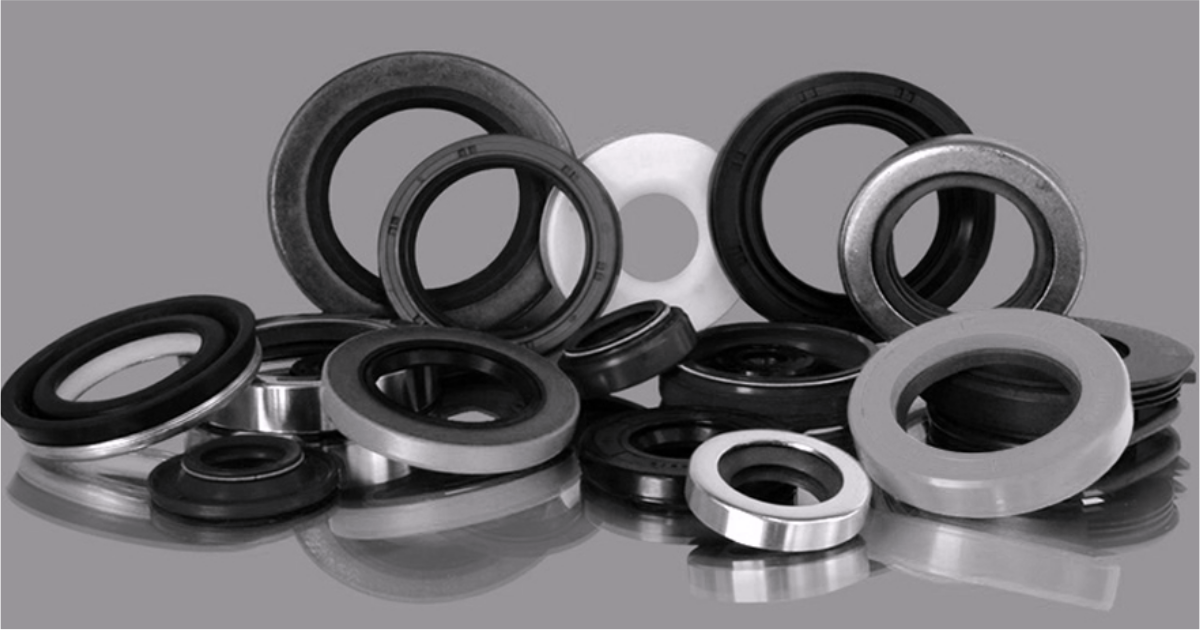
Optimizing Seal Selection: From O-Rings to Press-In-Place Seals
What is the right seal for my application? The question is simple, but the answer may not be as straightforward as you would expect.
The inputs for selecting the proper seal type are complex.
- Is it a static or dynamic seal?
- Is it a face seal or radial seal?
- How is the seal installed during assembly?
- What options are available for seal retention?
- Is there room in the mating hardware for a gland?
- Is the seal footprint simple or complex?
- Are there multiple ports to be sealed?
- Is redundant sealing a requirement?
- Will the component be serviced regularly, or is it sealed once for the duration of its life?
- Does the seal need to be replaceable?
- Can multiple components be incorporated into a single item reducing BOM complexity?
- What is the production volume?
As we work through the decision tree of possible inputs, eventually we begin to zero in on the ideal seal type to meet the demands of the application.
In its simplest terms, seal selection draws on Occam’s razor: The right seal for any application is the simplest one that meets all the requirements. At the lowest complexity, we find the O-ring. Elegant in its simplicity, round cross section/round footprint, it has a been used to prevent fluid loss for over a century. Its versatility was so widespread that standards were created to facilitate its use.
O-rings are easily manufactured in extremely high volumes across a wide spectrum of materials. They can be used in both static and dynamic applications. They can withstand high pressures. Properly designed, they can provide years of leak-free operation. Standard sizes mean no tooling costs and relatively short lead times. It is generally the lowest cost solution. However, O-rings do have some drawbacks.

Difficult to manufacture dovetail grooves are often required for seal retention. The closure force needed to compress an O-ring can be quite high. They require the smoothest surface finish of all seal options; 16 RMS for gas, 32 RMS for liquids. Also, once the joint is assembled, it’s impossible to verify that the seal has been correctly installed.
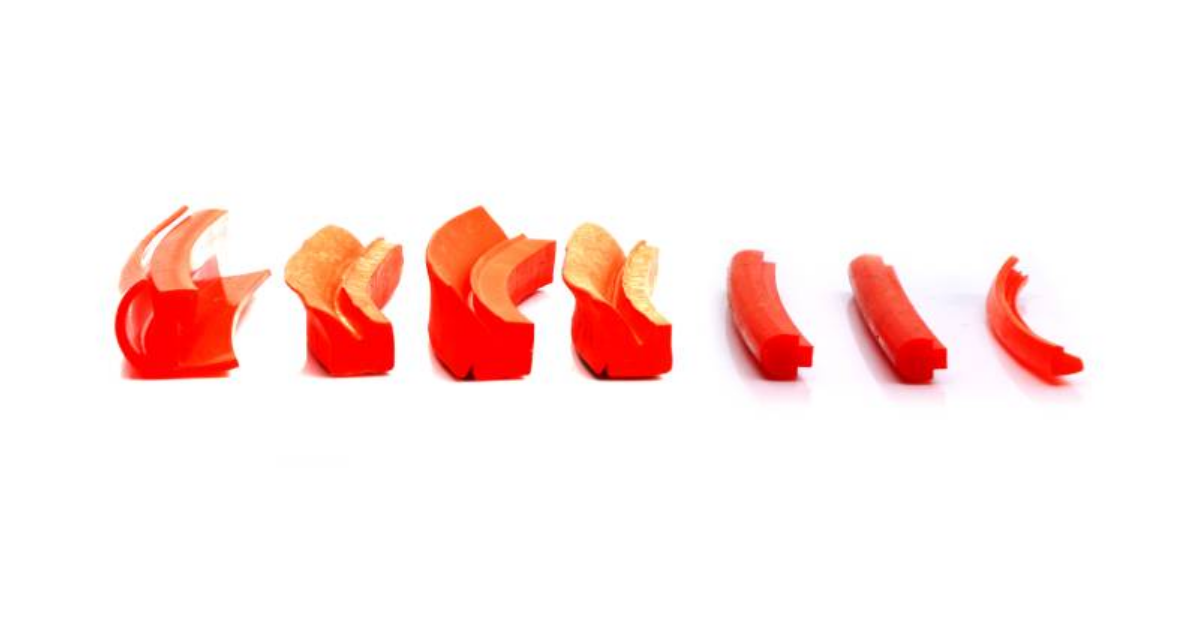
Maintaining many of the O-ring’s benefits and solving a few of its shortcomings, is the press-in-place or PIP seal. PIP seals are small cross section homogeneous rubber shapes that can be molded to match complex gland geometry- even branched seals. This simplifies installation, essentially allowing the seal to “drop in” to the gland, often combining the need for multiple O-rings into a single seal. They can include retention features that eliminate the need for a dovetail groove and allowing secure retention in a straight wall groove. This simplifies manufacture of the mating hardware. The groove is narrower than the wide, rectangular groove required by an O-ring, requiring less real estate in the hardware. In addition, due to the smaller footprint, many PIP seals have lower closure force than an O-ring.

Sometimes, a groove in the mating hardware isn’t desired or feasible. For those applications, we can select a seal type that creates its own gland. This type of construction has an elastomeric seal bonded to a rigid substrate or “retainer”. These typically come in 2 configurations: edge bonded seals (Integral Seal) or volume/void seal (Gask-O-Seal). The retainer limits the compression of the seal preventing it from being stressed beyond its physical limits. Because of this, no special torque sequence is needed. The mating hardware is simply bolted together “metal to metal” around the seal, with the bolt force being transmitted through the retainer. This creates a strong, stable interface desired in high demand applications. The integral seal, in particular, is well suited to high volume manufacturing in that sheets of raw material can be stacked, and multiple retainers cut at the same time. Because these types of seals are typically designed for higher compression, they can seal rougher surfaces (up to 125 RMS) and higher pressures. Multiple port sealing can be incorporated into a single retainer, reducing bills of material while eliminating the possibility of missing a seal. The retainer edge is visible after the joint is assembled providing peace of mind that the seal is properly in place.
When a truly turnkey solution is needed, we can incorporate a seal right into the mating hardware. This is a special configuration of the Gask-O-Seal where Parker can vulcanize an elastomeric seal directly onto a structural component of the assembly, such as a cover or housing. Since the seal is bonded into the groove, it eliminates one tangential leak path. Multiple features can be incorporated into this type of seal including inserts, captive fasteners, finishes such as anodize and paint, dampener pads and more, greatly reducing part count and simplifying installation for the end user.
These are few of the main types of static seals. There are variations of each that are indicated for special applications. Given the complexities of seal selection, the process can be greatly simplified by working with a manufacturer who can supply all of them.
Gallagher Fluid Seals is a Parker Distributor is proud to be proud to be one of the few premier distributors to qualify as a “Parker Seal Technology Center (STC)”.
Article re-posted with permission from Parker Hannifin Sealing & Shielding Team.
Original content can be found on Parker’s Website and was written by Nathan Wells, application engineer, Engineered Polymer Systems Division.