Seals for Data Centers
Increased thermal management requires increased needs for sealing solutions.
The Rising Need for Thermal Management in Data Centers
The need for enhanced thermal management is not expected to decline or even plateau. Highly demanding industries, the blistering pace of technology advancements, and the increasing use of multi-core chips are forcing data centers to deal with hotter temperatures. What’s more, airflow through data centers is increasingly hindered as dense new arrays of equipment are added.
Gone are the days when data centers could just turn up the air conditioning and add more fans. Those steps cannot keep up with the heat generated by the increasing number of chips operating at soaring levels of storage and processing.
Data Centers Choosing Liquid Cooling
For these reasons, an increasing number of data center managers are looking toward liquid cooling. Formerly considered a risky choice by those who feared the prospects of liquid contacting electronics, liquid cooling is fast gaining converts among those whose responsibilities include efficient, effective thermal management.
Direct CPU Cooling represents a majority of the market and relies on cold plates mounted directly to the heat-generating chips that route a water-based coolant for thermal transfer.
Liquid Immersion represents a smaller share of the market and can be separated out further into single phase or 2-phase. Single-phase Liquid Immersion Cooling typically involves synthetic hydrocarbon dielectric fluids with the entire server immersed in coolant. Two-phase cooling involves spraying an evaporating coolant directly onto the circuit, then collecting and condensing the coolant for re-use.
The fact liquid cooling is no longer viewed as off-limits in data centers can be attributed to the high level of design, engineering, and manufacturing control directed to the necessary hardware reflected in the increasing design of modular CPU’s and GPU’s. Modularity allows for upgrades and replacements without the need for specialized tools or processes like welding, but with modularity comes an increased need for reliable sealing solutions for increasingly complex and custom design requirements concerning o-rings, gaskets, and diaphragms.
Reliability, of course, cannot be taken for granted. Datacenter managers should consult with their designers and engineers involved in the manufacturing of liquid cooling systems to learn the performance attributes and test results of critical parts and assemblies. As more information becomes available about liquid cooling systems’ benefits and performance, especially in the area of mitigating risks associated with leaking liquids, smart decisions are easier to make.

Sealing Solutions for Data Centers:
In liquid cooling systems for data centers, various types of seals are used to ensure leak-free operation and maintain the integrity of the cooling system. Here are some common types:
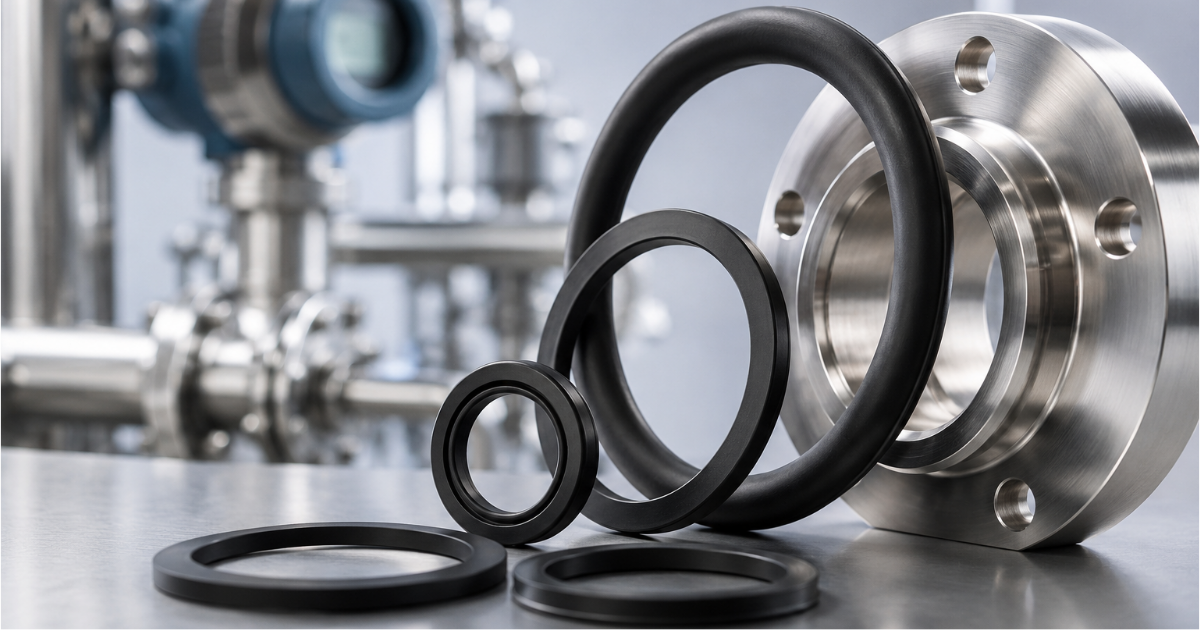
1. Custom Rubber Seals: These seals are uniquely designed to compress between two surfaces to create a tight seal. They are primarily used in applications where off-the-shelf seals are not a good fit or where multiple seals can be combined into a single design.
• O-Rings: These are widely used due to their simplicity and effectiveness in creating a tight seal. They are typically made from elastomers like silicone, EPDM, or fluorocarbon, which can withstand different temperatures and chemical exposures.
• Gaskets: These are flat seals placed between two surfaces to prevent leakage. They can be made from materials such as rubber, silicone, or PTFE, and are often used in flanged connections.
2. Dripless Connectors: These are specialized connectors designed to prevent fluid loss during connection and disconnection. They are particularly useful in modular systems where components may need to be frequently swapped out.
These seals are critical for maintaining the efficiency and reliability of liquid cooling systems in data centers, ensuring that the cooling fluid remains contained and the system operates effectively, but not all seals are made the same.
Material Compatibility and Reliability
Proper material testing is essential for ensuring the reliability and safety of seals in sensitive environments. For seals, fluid immersion tests, where materials are exposed to specific fluids at a given temperature and physical properties are measured before and after, help predict material behavior in different environments.
1. Volume Change: This evaluates the swelling or shrinkage of the seal material. Volume change is a critical indicator of fluid compatibility, as excessive swelling or shrinkage can lead to seal failure. In addition, Volume change in a material indicates extraction liquid ingredients (plasticizers) from the rubber seal or absorption of the cooling medium into the rubber seal. Both are problematic. In the case of long-term exposure, the extraction of plasticizers can contaminate the coolant and increase its conductivity.
2. Compression Set: This measures the material’s ability to return to its original thickness after being compressed. A high compression set indicates that the material may not recover well, leading to potential leaks.
3. Visual: Visual inspection for changes such as cracking, discoloration, or surface degradation provides additional insights into the material’s condition.
4. Other physical properties measured pending application requirements are hardness, tensile strength, and elongation at break. Changes in any of these three properties can indicate degradation or weakening of the material.
IRM 901 oil (and the older ASTM #1 oil) is the relevant standard test fluid for evaluating seal compatibility with hydrocarbon-based dielectric/heat transfer fluids. In general, a small amount (1-2%) of shrinkage or swell (up to about 10%) is acceptable. Below shows how various seal materials generally perform per IRM 901. For water/glycol coolants, these recommendations are reversed.
However, volume swell is not a good indicator of long-term performance. The damage in hot water/glycol coolants is cracking, hardening, and accelerated compression set. Unfortunately, testing for these failure modes is often overlooked when determining the appropriate sealing solution.
Material selection is critical in proposing the integrity, functionality and safety in various thermal management systems, but material selection is only the first step. Proper design and engineering support are critical in making sure that seals perform as intentioned. The following case studies demonstrate where the right material, design, and implementation were needed to come together to create the right solution for each customer.
Seals for data center are indispensible
Regardless of the liquid cooling methodology—whether it’s direct-tochip, immersion, single-phase, or twophase cooling—or the implementation strategy, be it full conversion or a hybrid system, reliable sealing solutions are indispensable. The success of these cooling systems hinges on the design, material selection, reliability, and integration support of the seals used. These factors ensure that the cooling fluid remains contained, preventing leaks and maintaining system efficiency. By prioritizing high-quality sealing solutions, data centers can achieve optimal performance and longevity, safeguarding their critical operations.
The original article can be found on Parker's website here.
Gallagher Fluid Seals is an authorized distributor and Seal Technology Center for Parker. Contact us for all your data center needs.