ptfe
- April 16, 2026
The Perfect Wave: The Gerromatic Rotary Seal
Gear motors, pumps and stirring units keep process material in constant motion in the process industry’s production facilities. A large number of shaft seals are used at drive shafts to keep liquids securely within the equipment. But leaks may be more likely to occur if the pressure acting on the seals becomes too great. Freudenberg Sealing Technologies has developed a new rotary seal, the Gerromatic, which has a wave-shaped sealing lip. This increases the maximum amount of pressure that can be applied. The sinusoidal contact path also reduces friction and provides self-cleaning, which extends operating life.
In the process industry, including the food and beverage sector, shaft seals used in equipment mostly have a rotation-symmetrical seal lip, which abuts the rotating shaft with a groove-like contact pattern. During wet-running, this can cause the medium to be displaced at the contact surface. The seal then runs in a more or less dry condition, leading to increased friction and higher temperatures. The increased friction increases wear and reduces the efficiency of the equipment. The accompanying rise in temperature is not desirable, especially when the process media are temperature-sensitive. If the seal lip is also exposed to high temperatures at high rotational speeds – for example, due to a process material that applies pressure to the seal lip in a vessel with a stirring unit below it – the lip can fold down on the low-pressure side, which would result in immediate leakage and the seal’s failure.
- July 21, 2025
Elastomer Technology in Mechanical Seals
Evaluate properties of rubber during installation and seal life.
Elastomers (or rubbers) are a ubiquitous family of materials whose use stretches across nearly the entire range of mechanical seal designs. From plant-sourced natural rubber, so named by John Priestly in 1770 for its utility in rubbing away pencil graphite, to petroleum-sourced synthetic rubber first developed around the turn of the 20th century, the "elastomer" and their properties are familiar but should not be overlooked—especially when dealing with mechanical seals.
How Elastomers Work in Mechanical Seals
Rubber seals come in a variety of profiles—O-rings, cup gaskets, bellows diaphragms, sealing/wiper lips and many others. They are classified as either static or dynamic and create positive pressure against surfaces to eliminate or control the leakage of liquids and/or gases while preventing the entrance of external contaminants such as dust and dirt. Static sealing occurs between adjacent surfaces with no relative motion, such as between the pump casing and cover. Due to frictional wear and heat generation, dynamic sealing is less straightforward, occurring between adjacent surfaces that are continuously or intermittently moving relative to another, such as between the pump casing and shaft.
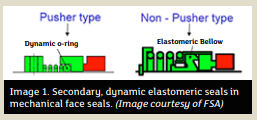
In mechanical face seals, elastomers tend to take second chair because the primary seal—the dynamic seal between the housing and rotating shaft—is achieved by sliding contact between the pair of stiffer, lapped-flat sealing faces, one stationary in the housing and one rotating with the shaft. In many designs, rubber provides the secondary seal between each seal face and adjacent surface. One seal face is fixed and sealed statically using an O-ring or cup gasket. The other is spring-loaded and requires a semi-dynamic seal to accommodate some axial play, such as a dynamic O-ring in pusher-type mechanical face seals or elastomeric bellows in nonpusher ones. These semi-dynamic applications (involving flexing and sliding of the elastomer) can be critical for maintaining proper contact between the faces through face wear, shaft movement, etc.
Common Applications
Although the seal face pair tends to be the most critical design feature, mechanical face seals are often used in the most demanding applications.
Rubber technology features prominently in radial lip seals, where typical applications have lower pressurevelocity (PV) values relative to those involving mechanical face seals. Still, the flexible elastomer lip must handle considerable relative motion in the form of shaft/bore rotation, reciprocation or a combination of both. In addition to standard designs and sizes, numerous customizations and proprietary approaches exist. The simplest designs rely on a single rubber lip’s inherent resiliency, although common enhancements include multiple sealing lips, a circumferential garter spring installed in a groove over the sealing lip to maintain contact with the shaft, and an auxiliary wiper lip or “excluder” to prevent abrasive dust or debris from compromising the primary sealing surface. For improving service life and performance in rotary applications, unidirectional or bidirectional hydrodynamic pumping aids can be added in the form of custom-shaped extrusions on the backside of the sealing lip to return leaked fluid to the sealing interface, increase lip lubrication and lower operating temperatures.
Benefits of Rubber
The definition of an elastomer provides initial insight into where rubber gets its resilient sealing quality: “a macromolecular material which, in the vulcanized state and at room temperature, can be stretched repeatedly to at least twice its original length and which, upon release of the stress, will immediately return to approximately its original length.”
When the rubber is squeezed by the adjacent surfaces of the clearance gap to be sealed, it has the characteristic
properties of malleably deforming and taking the shape of each surface in response to the stress and applying a force back against the surfaces in its attempt to return to its original dimensions. Elastomers consist of large molecules called polymers (from the Greek “poly” meaning “many” and “meros” meaning “parts”), which are long chains of the same or different repeating units, called monomers, usually linked together by carbon-carbon bonds (the
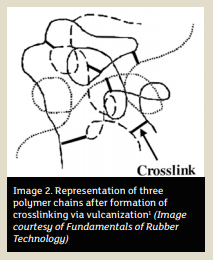
most notable exception being silicone elastomers, which are linked by silicon-oxygen bonds). Soft and hard plastics are also composed of polymers. However, the regularity of the monomers in their polymer chains allows neighboring segments to align and form crystals, making the macromolecular plastic material rigid and inelastic.One can prevent this crystallization by breaking up the regularity of the polymer chain, resulting usually in a viscous “gum” that is readily shaped into molds. At the molecular level, the polymer chains are similar to spaghetti-like strands flowing past each other.
During the process of vulcanization, or curing, the viscous liquid is heated with sulfur or peroxides and other vulcanizing agents, and crosslinks form between polymer chains, tying them together with chemical bonds, converting the gum into an elastic, thermoset solid rubber that retains its shape after moderate deformation.
In addition to the selection and preparation of base polymer(s) and cure system ingredients, formulating the final rubber product, also known as compounding, involves five other broad categories of ingredients, which have percentage compositions expressed in parts per hundred rubber (phr). Fillers include various powders that thicken the polymer mixture, improve strength and resistance to abrasives, and reduce final cost. Plasticizers are oils and other liquid hydrocarbons that lower viscosity to ease processing, soften the final compound and in some cases improve low temperature performance. Process aids are specialized chemicals added in low concentrations to improve mixing, flow properties and final appearance.
Antidegradants protect the rubber from environmental attack. Finally, various miscellaneous ingredients may be added for special purposes, including foaming agents, dyes, fungicides, flame
retardants, abrasives, lubricants and electrically conductive particles. A simplified description of processing these ingredients includes mixing via tangential or intermeshing mixers, forming into desired shapes and vulcanizing into the final product. - October 15, 2024
Investigating Compression Packing Failures
Over-tightening, excessive speed and improper installation can cause a system to falter.
In many respects, troubleshooting and failure analysis of compression packing materials is similar to the investigation of a crime scene. A good investigator knows how to gather clues from many different sources and put them together to understand what has happened. A good troubleshooter uses the same information gathering method, familiarizing themselves
- July 02, 2024
Gallagher Fluid Seals is a Parker Distributor and is proud to be one of the few premier distributors to qualify as a “Parker Seal Technology Center (STC)”.
Reduce Maintenance Costs When Sealing Dry Running Equipment
Pneumatic tools are common in factories, tool shops, and DIY garages around the world. Using compressed air for power is convenient, simple, and — when maintained properly — safe and efficient. However, air treatment costs can add up fast. Traditional
- June 18, 2024
GORE® Gasket Tape
GORE® Gasket Tape is a 100% ePTFE form-in-place gasket that delivers worry-free sealing performance for large steel flanges (Series 500) and large glass-lined steel equipment (Series 1000). While this product has a number of advantages, a few years ago, GORE® made a significant design change in the adhesive size to ensure easier placement and handling of their proprietary gasket tape.
- December 28, 2023
ePTFE from GORE
Expanded polytetrafluoroethylene, or ePTFE, is the core material in many of Gore’s solutions. An ePTFE membrane is created when PTFE — a linear polymer consisting of fluorine and carbon molecules — is expanded, creating a microporous structure with very desirable characteristics, including a high strength-to-weight ratio, biocompatibility, high thermal resistance and many others.
- October 27, 2023
Abrasive media comes in many forms—from mining slurries to wood pulp and even substances as seemingly mild as liquid chocolate. This diversity rules out a one-size-fits-all solution for abrasive pumping applications. However, today’s broad range of materials, from carbon fiber packing to graphite-filled polytetrafluoroethylene (PTFE) bushings, includes products capable of meeting an equally broad range of abrasive wear requirements.
Carbon Fiber Packing
Few materials offer the
- August 29, 2023
Gallagher Fluid Seals is a Parker Distributor is proud to be proud to be one of the few premier distributors to qualify as a “Parker Seal Technology Center (STC)”.
Article re-posted with permission from Parker Hannifin Sealing & Shielding Team.
Original content can be found on Parker’s Website
- July 05, 2023
Since 1958, Gore has developed products that improve lives. At the center of these solutions is polytetrafluoroethylene (PTFE), a polymer with exceptional properties like high tensile strength, a low dielectric constant, UV resistance and many more. In 1969, the possibilities for PTFE expanded with Bob Gore’s discovery of expanded PTFE, or ePTFE.
In the years since, Gore has developed unparalleled expertise in manipulating ePTFE and other fluoropolymers. Gore's engineers can change a material’s structure, shape, thickness and surface geometry, then pair it with complementary materials to provide the performance qualities required by the application and the customer. The resulting product can be strong or permeable, rigid or flexible, thin or thick — with many additional combinations of properties that can be applied to meet the end use requirements.
Since its very founding, Gore has been passionate about solving the complex challenges of their global customers. From the first suggestion of a product need, to its delivery to market, this passion is apparent in everything Gore does.
- Curiosity: From keeping water off a person’s skin to preventing leaks from happening in chemical containers, Gore listens to their customers and analyze the challenges to determine the underlying problem.
- Competency: Gore determines how they can apply their expertise in fluoropolymer science to deliver solutions that are valued and differentiated from the competition.
- Commitment: Gore rigorously tests their products to ensure they deliver failure-free performance and suit their customers’ needs and applications, the first time and every time.
- June 02, 2023
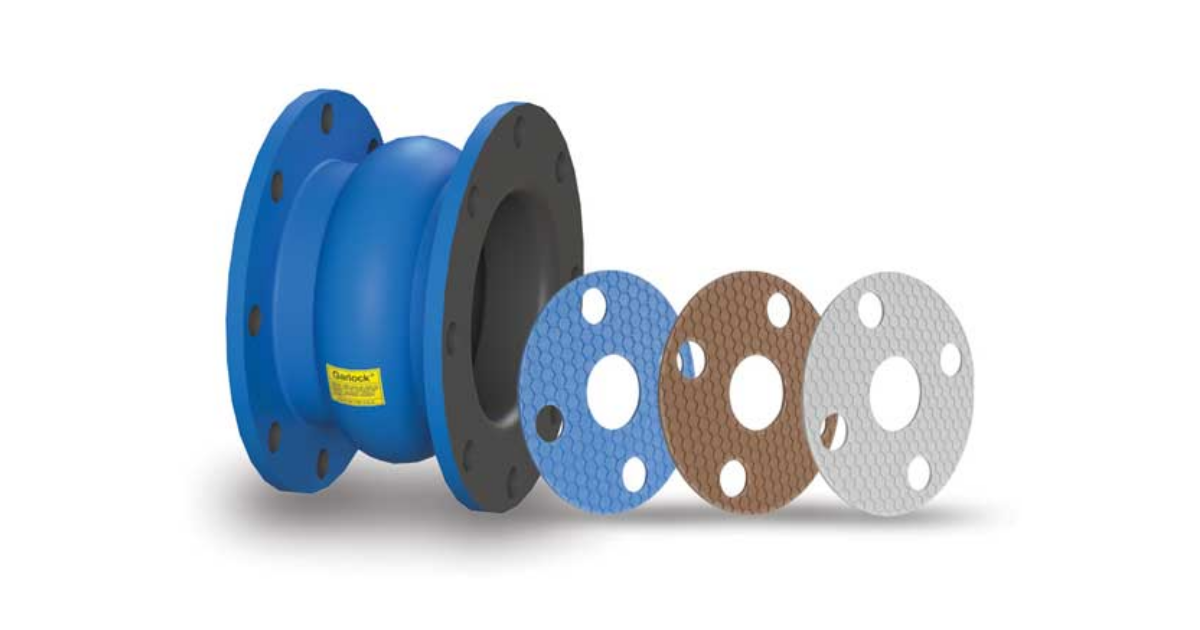
GYLON EPIX™
GYLON EPIX™ is a newly developed family of PTFE gaskets. It is manufactured using a patented, profiled surface based on Garlock's proven Fawn, Off-White, and Blue GYLON® to create highly conformable materials for optimum sealing performance.