Vesconite Helps Elminate Grease Burden

Equipment operators and maintenance engineers are no strangers to the time-consuming task of re-greasing bushings. Despite the availability of some automated greasing systems, much of the world’s lubrication is still carried out manually, one grease point at a time.
Each grease point takes between three and five minutes to service using a hand-held grease gun. While this may appear manageable in isolation, the cumulative time across all grease points on a single machine can be significant.
Take, for example, standard heavy-duty equipment used in earthmoving and construction. A typical 1.4-ton bucket excavator may have 18 grease points. A 213HP fly-wheel grader might include 25 grease points, while a 31-ton truck could feature 22, and a 7.7-ton bucket loader often has around 20. For each machine, this translates into an hour to an hour and a half of labour—just for lubrication.
And that’s not where the cost ends.
“Some of these points require greasing weekly or monthly,” notes Eddie Swanepoel, technical consultant at Vesconite Bearings. “But many high-use machines need lubrication daily—seven days a week. That can mean seven to ten and a half hours per week per machine devoted entirely to greasing.”
In fleet or plant environments where several such machines are in operation, the total labour requirement for lubrication can escalate dramatically, reducing operational efficiency and tying up skilled workers in repetitive maintenance.

Maintenance-Free and Grease-Free Bearings from Vesconite
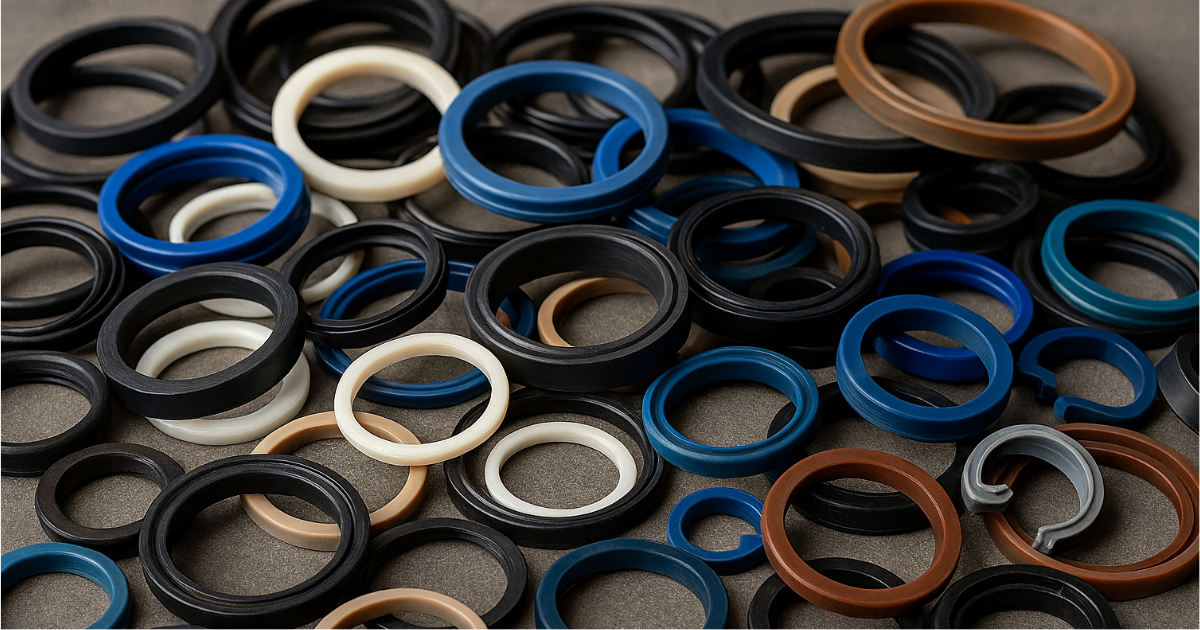
In response to this growing maintenance challenge, Vesconite Bearings is advocating for a move toward maintenance-free, dry-running, and grease-free bearing solutions. Vesconite Bearings’ proprietary bushings are designed to run without the need for lubrication. Their self-lubricating properties eliminate the need for manual or automated greasing, offering significant time and cost savings.
“These bushings are corrosion-resistant, suitable for dirty and wet environments, and they don’t require any oil or grease,” says Swanepoel. “The time currently spent on greasing could be far more profitably allocated to other maintenance or operational tasks.”
Self-lubricating bearings are already seeing wide adoption in industries where downtime is particularly costly—such as mining, construction, agriculture, and materials handling. In these sectors, the shift away from traditional metal bushings with frequent grease requirements is not only increasing uptime but also helping companies meet sustainability targets by reducing lubricant consumption and waste.
“Labor efficiency is a critical driver for our clients,” adds Swanepoel. “Whether you’re maintaining a single excavator or a fleet of 50 machines, the savings in maintenance time can be substantial. Add in the cost of grease, potential contamination from over-lubrication, and bearing failure due to missed lubrication cycles, and the case for self-lubricating bushings becomes even stronger.”
Vesconite Bearings’ self-lubricating bushings are available in a range of sizes and formulations to suit different applications, from high-load, slow-speed operations to high-impact environments.
For operations looking to reduce their maintenance load, increase equipment availability, and eliminate the risks associated with manual greasing, self-lubricating bushings offer a practical, tested solution.
The original article can be found on Vesconite's website.
For more information about Vesconite, or to start a custom project, contact us today.