eclipse engineering
- December 15, 2025
Why an Extrusion Gap is Important
“How much pressure can this seal handle?”
The answer to this question depends on a number of parameters and conditions. But the principle limiting factor in the pressure handling of any seal system is the extrusion gap.
Commonly referred to as the “E-Gap,” the extrusion gap is one of the most critical design aspects in any high-pressure application. Seal design, type, and material are all influenced by the extrusion gap and the desired pressure handling capability.
What exactly is an extrusion gap, and why is it so important in the successful design of a sealing system? Let’s find out.
The Basics: What is an Extrusion Gap?
In terms of sealing systems, the extrusion gap is defined as the clearance between the hardware components.
In a piston configuration, this would be the clearance between the piston and bore. In a rod configuration, this is the clearance between the rod and housing it’s passing through.
The extrusion gap can be expressed in terms of radial or diametral clearance, which can lead to some confusion. Our partners at Eclipse define the E-Gap by stating it as the radial clearance. The radial clearance is equal to the diametral clearance divided by two.
It’s important to note that while hardware components might be machined to have a specified clearance, this gap might not be perfectly realized or maintained.
- October 23, 2025
Designing the Perfect Rotary Shaft Seal
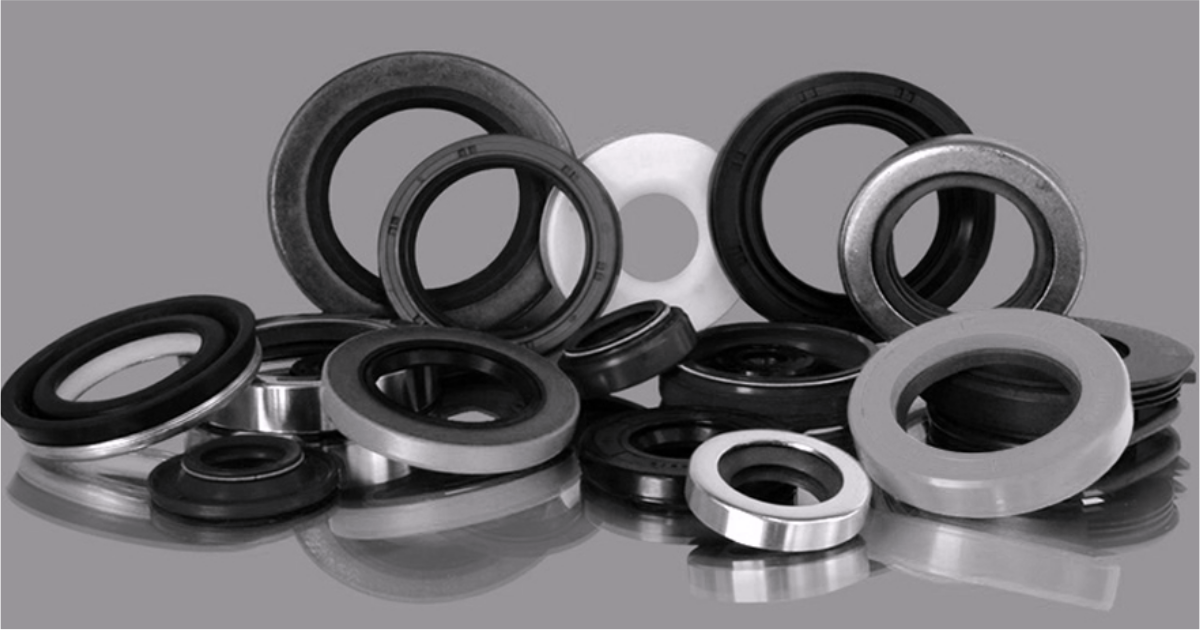
When it comes to maintaining a high-functioning rotary shaft, you need to select the appropriate lip seal.
The shaft seal protects the rotary shaft from contaminants such as dust and dirt, and it keeps water out and lubricant in.
A rotary seal, also known as a radial shaft seal, typically sits between a rotary shaft and a fixed housing — such as a cylinder wall — to stop fluid leaking along the shaft. The rotary seal’s outside surface is fixed to the housing, while the seal’s inner lip presses against the rotating shaft.
Common applications for shaft seals include motors, gear boxes, pumps and axles. They’re also increasingly used for food and chemical processing, as well in pressurized gas applications.
Three of the most important considerations when the choosing the best lip seal for a rotary shaft are:
- The material the seal is made of,
- the hardness of the shaft’s surface, and
- the roughness of the shaft’s surface.
Did you know that Gallagher Fluid Seals manufactures Rotary Seals in-house?
At Gallagher Fluid Seals, we’ve invested in state-of-the-art manufacturing technologies and processes to produce high-performance rotary seals tailored to our customers’ exact specifications. Whether you need a standard rotary seal or a fully customized solution, our engineering and production teams work closely to deliver seals that meet and exceed industry standards. Learn more about our Rotary Seal manufacturing capabilities here.
Here’s your quick go-to guide on how to achieve optimum performance and longevity for your seals and shafts, ultimately minimizing the risk of seal failure.
- May 28, 2025
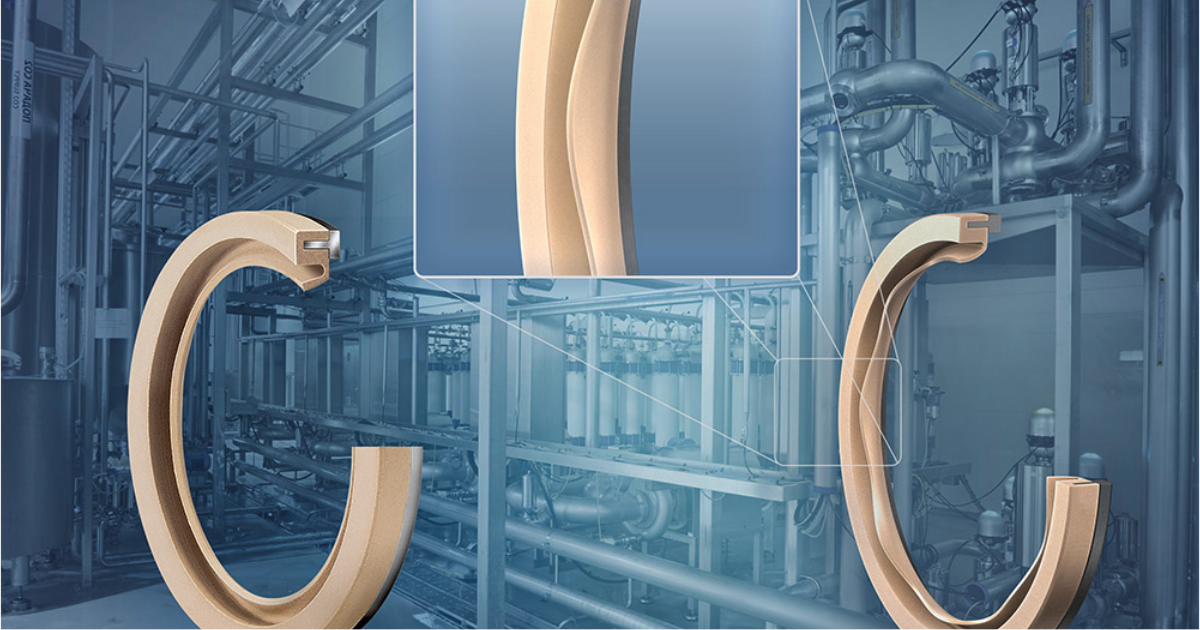
Here we’ll discuss the basic functionality and design principles of spring energized seals and discover why one might be the perfect sealing solution in your application. This article was written by GFS supplier/partner Eclipse Engineering.
Spring energized PTFE seals perform reliably in a variety of applications where conventional elastomeric seals fail due to chemical attack, extreme heat or cold, friction, extrusion or compression set.
- June 14, 2024
Cryogenic Seals
When designing for low temperature sealing, the first step is to define the temperature range that the seal will be operating in.
Typically, cryogenic as seals are those that are operating below -65 Fahrenheit. Gallagher's partner, Eclipse, chooses this benchmark because they currently have elastomers that have a usable TR10 value at this temperature.
When designing at this level — with high temperatures around 300 Fahrenheit — an understanding of what level of
- November 09, 2023
Back-Up Rings
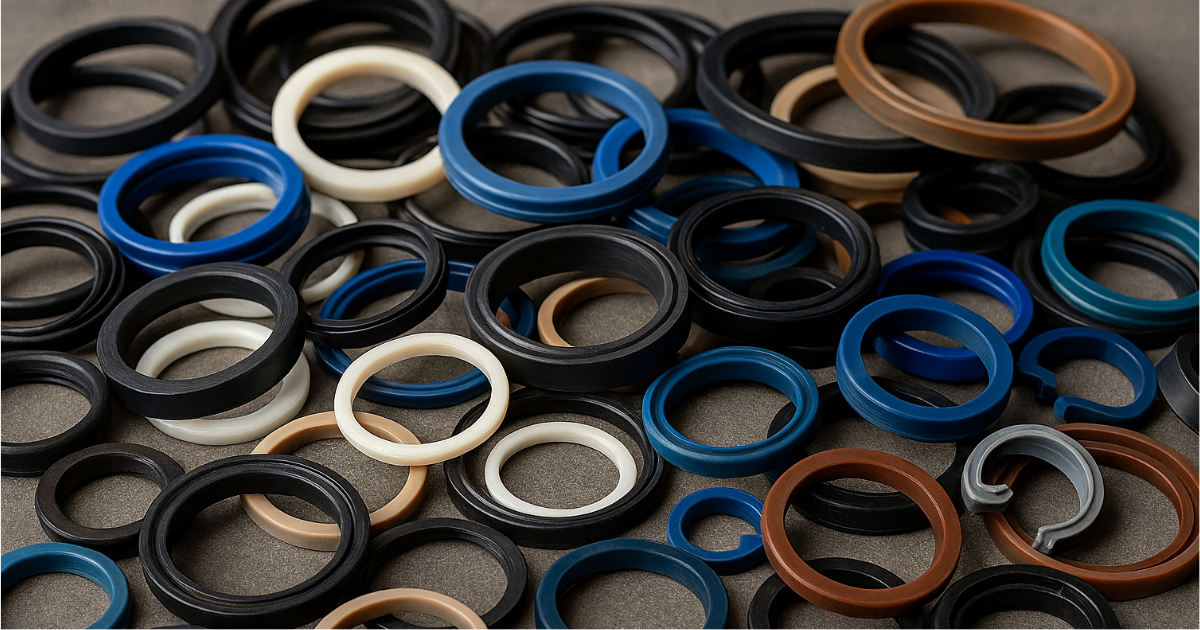
Back-up rings serve an important role in world of seals. While the design principle and construction are incredibly simple, they greatly extend the usefulness of the most common and prolific sealing device in the world: the O-ring.
Back-up rings are aptly named as they do just that: they back-up an O-ring.
Back-up rings are commonly nothing more than a ring of polymer meant to space the O-ring away from the extrusion gap in hardware. By blocking off the extrusion
- December 29, 2022
In the world of engineering, machinery, and mechanical systems, dust can be the difference between a reliable piece of equipment and disaster.
Dust can cause major damage to cylinder walls, rods, seals and other components inside of machinery. And if you’re not careful, dirt, mud, debris, and water can all cause damage as well.
These foreign contaminants are real problems for mechanical systems, especially as they build up in small quantities over time. A single particle of dust today
- October 20, 2022
Channel Seals for Hydraulic and Pneumatic Systems
The Channel Seal (or Cap Seal, as it’s often referred to), was one of the earliest forms of Polymer or Teflon sealing in the seal industry.
The product is easily applied. It didn’t replace the O-ring, but instead offered improved life while reducing drag.
In doing so, hydraulic and pneumatic systems operated cooler and quieter, while improving overall performance of the product.
- October 07, 2022
A combination of crimped can seals will handle a variety of applications when a rubber lip seal is not your solution.
Rotary seals are often secured in sealing hardware by crimping the sealing element in a metal can. One of the most common rotary seals is a molded rubber lip seal in a can.
While not crimped, the can retains the sealing element, and stops the seal from rotating in the gland. Rotary
- September 15, 2021
With the marijuana and cannabis industry expected to take in nearly $24 billion by the end of in 2021, and more than $40 billion by 2025, the market is primed for innovation in production volume and technology.
The growth in popularity of vaporizers, infused edibles, and topical cannabis products means the demand for cannabis oil extraction is a fast multiplying industry.
The two primary means for oil extraction is via petroleum based solvents such as butane or propane, or by supercritical
- July 16, 2021
As the operating parameters of industrial technologies and manufacturing processes get more extreme, the need for optimal sealing solutions become that much more important.
Elevated temperatures and pressures, higher speeds, extreme environments, faster gas decompression, and aggressive medias all make sealing more critical. This extends right across static, reciprocating, rotary, and oscillating applications.
This challenge has been met very effectively