garlock
- October 15, 2019
A flexible choice can adapt to permanent misalignment, preventing future damage.
Keeping aging facilities and equipment maintained is an ever-changing task that can jeopardize the goal of maximizing uptime. Years of thermal cycling, vibration or foundation settling can disorient piping or pumps. Piping engineers will use rubber expansion joints to account for these types of challenges in a rigid piping system. Permanent misalignment can set in after years of operation. The original-size expansion joint could no longer be the best fit when it comes time to replace.
Replacing a permanently misaligned expansion joint connection with the original part could lead to reduced service life and/or missed expectations of the new expansion joint. Determining the best way to accommodate this when it comes time to replace the existing expansion joint can have long-term effects on reliability. Since the original components may not fit in the newly disoriented flange connection, they are limited in their reliability.
Types of Customization & Benefits
Expansion joints are designed to withstand the pressure retention of rigid pipes, yet be flexible and absorb misalignment induced in these systems. However, there are limits to exactly how much flexibility can be absorbed before damage occurs. Using this flexibility to connect two misaligned pipe flanges will take away from how much movement can be absorbed during the actual operational period when the system is running.
Attempting to retrofit a standard-size expansion joint to connect a misaligned pipe connection can put excessive stress on the component and could lead to a shorter operational service life. For this reason, the Fluid Sealing Association (FSA) recommends no greater than ±1/8-inch misalignment of the pipe flanges during installation. Depending on the severity of misalignment, it can be advantageous to implement custom expansion joints to minimize the stresses that cause these joints to fail or become damaged during installation.
Maintenance crews can also benefit by having a component that will fit precisely. Concerns for safety are present when attempting to put enormous pressure to compress, elongate or offset the joint so it will fit in place.
Custom expansion joints, made-to-fit, provide long-term dependability and can be designed in many orientations. To prevent overexertion, expansion joints are often constructed to connect nonstandard distances between pipe flanges. Other modes of misalignment can connect pipe flanges that are no longer centered.Face-to-Face Tailoring
Image 1. Stress area stretched axially during installation Years of cycling, wear and other factors can contribute to the disorientation of a particular pipe connection. The length of an expansion joint, a dimension commonly referred to as face-to-face, bridges the gap between two parallel pipe flanges. A common industry problem is created when foundations settle and piping support structures transition lower than where it was originally constructed (Image 1). Expansion joints are designed to account for this, but choosing the correct replacement will make the difference between continued reliable service life or system failure.
Stretching an expansion joint to fit the changed flange connection often results in immediate damage that is only sometimes visual to the naked eye. A stress point on the outer cover of the expansion joint will usually become visible at the transition corner between the flat portion and the base of the arch in the form of a crack. The severity of cracking, elongation and settling will be aggravated when pressure in the pipeline is turned on.
Depending on nominal pipe size, industry standards will include standard face-to-face sizes of 6, 8, 10 or 12 inches, according to the FSA. When a standard 6-inch face-to-face joint is removed, the length between flanges could have been elongated to 7 inches or more. Many expansion joint consumers are not aware of the capability to build the expansion joint to the required nonstandard 7-inch face-to-face since it is not a standard offering. Building the replacement expansion joint to the nonstandard 7-inch face-to-face will eliminate any initial stress imposed on the joint.
Lateral offset expansion joint. and Angular offset expansion - September 10, 2019
The search for the ideal Polytetrafluoroethylene (PTFE) gasket has been elusive. Competing applications and workplace variables have led to the creation of myriad solutions, yet none that has proven fully adaptable and appropriate for universal adoption.
Garlock Sealing Technologies considered this to be a critical yet entirely solvable shortcoming. And it is against this backdrop that in 2016, they set out to compile a comprehensive list of attributes for the ideal PTFE gasket — a wish list, as it were — in order to build a better gasket.
Working with a third-party survey development company, Garlock developed an exhaustive questionnaire that probed every aspect and functionality of PTFE gaskets, testing and adjusting the questions until they had a workable, finalized version.
Using this final questionnaire, Garlock conducted extensive interviews at 15 major chemical processor companies, speaking with 20 engineers responsible for process operations, projects, maintenance and reliability. The goal was simple: to discover the ideal characteristics and their relative importance that engineers sought in a PTFE gasket.
After several months of data collection, Garlock analyzed the feedback and noted the most popular responses:
- 28% of respondents said that they struggled with how different gaskets required different compressive loads and how to ensure that those gaskets had been installed properly
- 21% expressed frustration with the creep properties of PTFE gaskets
- 21% desired a gasket that seals with less compressive load
- 14% expressed frustration at the installation inconsistencies of their fitters
- 14% expressed frustration with leaking, especially after a successful installation and start-up
From those answers, Garlock drew the following conclusions, representing the most desirable and essential PTFE gasket characteristics:
- Seal: Seals easily
- Installation and assembly: Forgiving of poor installation or assembly practices
- Forgiving: Forgiving of poor flange conditions
- Retention: Maintains a seal after installation
- Flexible: Can be used in a broad range of services to avoid user confusion and reduce inventory
Introducing: GYLON EPIX
Garlock used this feedback in developing a next generation PTFE gasket — GYLON EPIX. Featuring a hexagonal surface profile, GYLON EPIX offers superior compressibility and sealing for use in chemical processing environments. Its enhanced surface profile performs as well or better than existing 1/16″ or 1/8″ gaskets, allowing end-users and distributors to consolidate inventory, lower the risk of using incorrect gasket thicknesses and reduce stocking costs.
GYLON EPIX checks off the most desirable gasket attributes:
- Installation and assembly: Even distribution of the bolt load over the contacted area of the gasket during the assembly process
- Retention: Retention of the bolt load administered at assembly
- Seal: Efficient translation of bolt load to sealing performance
- Forgiving: The ability to perform in imperfect flanges and installation conditions
GYLON EPIX with its raised, hexagonal profile allows it to perform the job of both traditional 1/16” and 1/8” gaskets. It accomplishes this by combining the bolt retention of the former with the forgiveness for bad flange conditions of the latter, a truly innovative feature for PTFE sheet gasketing.
- August 20, 2019
FLOOD-GARD Offers Bearing Protection in Challenging Flooded Environments
Garlock has launched FLOOD-GARD Bearing Isolators for flooded applications. The patent-pending seal design provides bearing protection even in the most challenging flooded environments, extending the life of rotating equipment such as gearboxes, pumps, and motors.
- July 17, 2019
Recent gasket failures in flanged joints of High Density Polyethylene (HDPE) piping.
Problem
HDPE piping joints are typically thermal fusion welded joints, but flanges may also be used. When flanges are used, an HDPE flange adapter with a metal backing ring is fused to HDPE piping, as shown in Figure 1. The HDPE flange adapters are used to connect to other flanged fittings, such as valves, elbows, tees, etc., with gaskets inserted between the flanged fittings.
Incident Description
- July 02, 2019
Wine Manufacturing with GYLON®
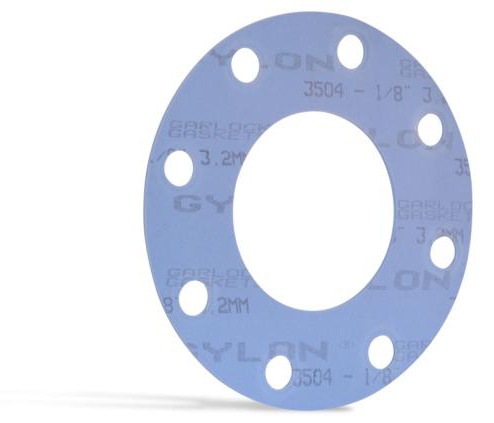
Gylon 3504
The GYLON® Style 3504 gasket is made of PTFE with aluminosilicate microspheres. It is designed for use in many acids, some caustics, hydrocarbons, refrigerants, and more.
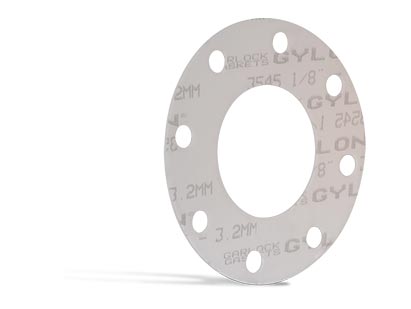
Gylon 3545
The Garlock 3545 style is a highly compressible microcellular PTFE with a rigid PTFE core for improved handlability. Garlock 3545, made with Gylon material, is designed to compress and conform to irregular or damaged surfaces, making it suitable for flanges that generate lower compressive stresses, such and glass-lined flanges and equipment.
INDUSTRY
Food & Beverage – Wine Production
CUSTOMER
An award-winning, family owned & operated winery in the heart of a major US wine-growing region.
BACKGROUND
The customer crushes, presses, ferments, bottles, and labels all of their wines at their winery, but having traditionally utilized EPDM gaskets, they faced ongoing issues with seal reliability. This was occurring during various stages of the winemaking process, but especially so during the sterilization procedures between each batch, with subsequent leaks creating issues in production reliability, housekeeping, and potential contamination.
CHALLENGES FACED
Business was growing rapidly so new equipment had been installed, but at the same time the number of maintenance windows was reducing. Therefore the customer was looking for a more reliable and sanitary product to improve efficiency and help to protect the sensitive product. As well as the need to remain absolutely compliant with industry standards, the customer also placed utmost importance on prevention of any adulteration of their award-winning wine. As well as working around limited windows of opportunity for production trials the critical and expert opinion of wine tasters was therefore essential to ensure full approval of any component change in the process.
- March 26, 2019
Fried Snack Foods and GYLON® Style 3504 Gasket
The GYLON Style 3504 gasket is made of PTFE with aluminosilicate microspheres. It is designed for use in moderate concentrations of acids, caustics, hydrocarbons, refrigerants, and more.
It provides a tight seal, improved performance over conventional PTFE, reduced product loss and emissions, reduced creep relaxtion, excellent bolt torque retention, it doesn't burn, will not support bacterial growth, plus many more benefits.
INDUSTRY
Food Processing – Fried Snack Foods
CUSTOMER
A major diversified food & beverage manufacturer, with facilities located in all regions across the globe.
BACKGROUND
The customer had persistent problems when sealing hot oil applications on its bulk snack food fryers across several production sites. Build-up of polymerised vegetable oil on the flanges caused unsightly mess, maintenance complications, financial implications, and posed a significant fire risk.
CHALLENGES FACED
As well as ensuring that the sealing material was compliant to FDA and EN1935 standards, the challenge was to ensure that the gaskets would perform well under the difficult conditions presented by the high oil temperatures. Additionally, because the production line was also subject to regular and aggressive cleaning cycles, the gasket material was required to be compatible with other aggressive chemicals across a broad pH range.
- February 26, 2019
Poultry Processing: KLOZURE® ISO-GARD®
ISO-GARD bearing isolators offer exceptional bearing protection for pumps, motors, and bearing supported industrial equipment under the harshest conditions.
ISO-GARD products are constructed using a filled PTFE material which provides excellent chemical resistance.
INDUSTRY
Food - Poultry Processing
CUSTOMER
A diversified food processing company, with facilities located
throughout the US.BACKGROUND
The customer had persistent problems with sealing the bearings in their non-metallic feather picker housings. Using standard lip seals, and with a monthly maintenance program, they still encountered frequent failures. With 72 assemblies (each with two sealing locations) this had a detrimental effect on manufacturing efficiency, and placed a significant burden on the maintenance teams.
CHALLENGES FACED
Poultry feathers were getting under the lip seals and into the bearing housing, causing frequent and unexpected failures. Daily wash-downs also used a chemical cleaning solution that could also damage the bearings if not sealed correctly. Additionally, there was limited space available for any modification of sealing element.
Meat processing environments are highly regulated by the FDA, so any manufacturing changes must be carefully controlled. Therefore the customer required close support to ensure that any changes could be implemented with full confidence.
- February 12, 2019
Replacing Aging Water Infrastructure With NSF Compliant Materials
There are over 155,000 public water systems in the United States and more than 286 million Americans who rely on community water systems daily. Since most of the infrastructure was built between the early 1900's and 1960 using outdated technology/products and capabilities, nearly everything is approaching the natural end of it's lifespan.
Some estimates put the repairs and replacement of the
- January 29, 2019
Expansion Joint Control Units
Elongation settings are a vital factor to assembly effectiveness.
It is no secret that one of the greatest demands for an expansion joint is the expectation to serve a long, leak-free life with little-to-no maintenance. Once installed, these flexible rubber connectors should require little attention. The preservation of this investment (and one’s sanity) can be maximized with an in-depth overview of how control units can prevent a new expansion joint from being overstressed.
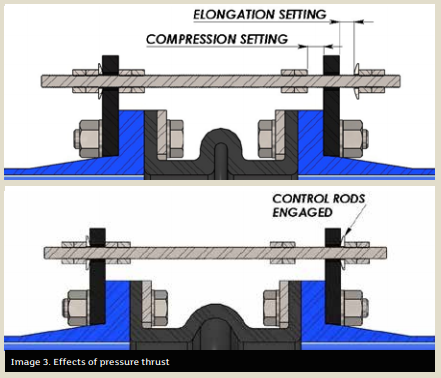
The purpose of a control unit is to act as a safety device against excessive movement resulting from pressure thrust. A typical control unit assembly is comprised of threaded rods, steel gusset plates, nuts and washers (see Images 1 and 2).
The usage of control units with an expansion joint is always beneficial; pressure spikes during a system upset can cause uncontrolled surges through the expansion joint. This is a prime example of how valuable it is to have control units installed to protect these rubber assets from damage.
Methods to the Madness
A common misconception about control units is that they are designed to support the weight of pipe members or act as a substitute for adequate mounting. They are not. The sole purpose of a control unit is to allow the expansion joint to move freely within a specific range of movement while preventing the joint from being overstretched from pressure thrust forces.
The control units in no way impede the joint from performing its other duties beyond movement (vibration absorption, cycling or compensation for misalignment). The few extra steps needed to install the control units with the expansion joint could pay notable dividends in the long run.
Pressure thrust plays a huge role in how an expansion joint functions. While under pressure, the forces acting on the inside walls of the expansion joint actually cause the joint to swell and elongate. In the real world, an expansion joint is held comfortably between two pipe flanges, which in most cases are restrained by a pump lagged to the floor or mounted to a structural beam. Although it may not be apparent to the naked eye, once the expansion joint sees pressure, it produces a thrust force that acts axially on both pipe flanges.
Theoretically, what would be the result if the expansion joint was unrestrained on each end while pressurized?
Without fixed ends, the pressure thrust would force the joint to elongate without bounds.
Most useful in high pressure applications, the control rods will engage with the gusset plates once a pre-specified amount of growth for the expansion joint has been reached, restricting the joint from stretching any further. At this point, the control rods are absorbing any additional thrust acting on the pipe flange, thus limiting the amount of stress that is exerted onto adjoining equipment.
The design theory for sizing control unit hardware is based on the pressure thrust. Nominal inside diameter (ID) and arch geometry of the expansion joint are key drivers for calculating the thrust force that will be applied to the pipe at maximum line pressure. Per
industry standards set by the Fluid Sealing Association (FSA), both control rods and gusset plates are designed to withstand no more than 65 percent of the yield strength of the material.
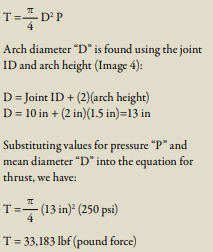
Magnitude of the pressure thrust can be calculated by knowing the internal pressure and the effective area of the expansion joint. Effective area is found using the arch diameter of the expansion joint, which takes into account the size of the arch.
For example, we can calculate the resulting pressure thrust for a 10-inch ID expansion joint using an arch height of 1.5 inches that is rated for a maximum pressure of 250 pounds per square inch (psi).
The equation for pressure thrust “T” is:
These design limitations based around yield stress are the reasons why some control units made from lower yield strength stainless steel contain thicker components or more rods per set than the standard carbon steel control units.
Installation & Inspection
For a control unit assembly to be effective, rod positioning and elongation settings are critical during installation. Each control rod should be evenly spaced around the flange to best distribute the load. Elongation settings (see Image 5) are often overlooked, yet are a vital factor to ensure the control units fulfill their intended use.
Every expansion joint comes with movement ratings based on arch size, configuration and number. These movement design ratings of the expansion joint are critical pieces of information that are absolutely required during the installation of control units. The general rule of thumb is the gap between the gusset plate and the nut should be adjusted to match the joint’s elongation rating.
Having this information at hand during installation is great, but what about the existing control units currently in operation? Visual inspections of these components are a basic task that goes a long way toward extending the life of the joint.
Here are the top 4 anomalies to look for when performing a field inspection:
- December 18, 2018
The ABRA-LINE™ family of products was developed for highly abrasive applications typically found in the power generation, fertilizer, mining and chemical industries. These may include flue gas desulphurization systems, phosphate mining, dry bulk power transfer systems, tailings and slurry applications. Our proprietary urethane formula was designed to reduce wear and extend
service life.Style 404 Expansion Joints are specially designed for full vacuum abrasive service applications. The tube material is a proprietary urethane formulation. Style 404 can be constructed as a single or multiple arch design. It can also connect pipe flanges in concentric or eccentric tapers, to join piping of unequal diameters.
Case Study: Chemical Processing
Industry
Chemical ProcessingObservation
A stainless hosing was used and would continuously fail due to abrasion on the leading edge of the hose. The hosing would last for 3 to 6 months before replacement.