gaskets
- June 18, 2024
GORE® Gasket Tape
GORE® Gasket Tape is a 100% ePTFE form-in-place gasket that delivers worry-free sealing performance for large steel flanges (Series 500) and large glass-lined steel equipment (Series 1000). While this product has a number of advantages, a few years ago, GORE® made a significant design change in the adhesive size to ensure easier placement and handling of their proprietary gasket tape.
- February 19, 2024
Gallagher Fluid Seals partners with the world's top gasket suppliers. Our strong partnerships allow us to provide you with the best gasketing options, from PTFE, Metallic, and Compressed Non-Asbestos
Choosing the Correct Semi-Metallic Gasket
There are many variations of semi-metallic gasket available in today's market. The combination of metal and a soft gasket material merges
- January 18, 2024
Enhancing the surface profile can improve sealing capabilities, extending the functionality of aging piping systems in chemical plants.
There are many aged and aging process plants in operation today. In fact, many of the processing plants for power, chemicals, oil, etc., have been in service for more than 50 years. And while the piping itself may remain intact, their bolted flange gasket joints and connections are becoming misaligned, corroded and damaged due to repeated handling, chemical
- May 18, 2023
The Best Gasket Types for Increased Heat
Under pressure? Absolutely. The increasingly high temperatures and harsh conditions to which gaskets are exposed makes selecting the right gasket all the more important.
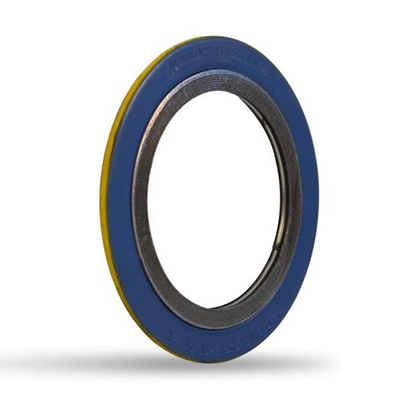
In industries such as chemical processing, hydrocarbon refining, and power generation, leakage from extreme temperature process streams can result in loss of efficiency and production as well as adverse environmental impacts and compromised employee safety. One of the most commonly used sealing products in systems subject to high pressures and temperatures is a spiral-wound gasket. These gaskets typically consist of filler and winding materials selected on the basis of application requirements and end-user preference. Proper selection of these materials is critical to achieving the desired performance in all applications.
Material Selection for High Temperature Gasketing
Sealing at temperatures above 850 ºF (454 ºC) is particularly challenging because of the limited number of filler materials that can resist thermal degradation at extreme temperatures – these temperatures affect both the sealing material and metal components. For instance, the yield strength of fasteners decreases as the temperature is increased. In addition certain chemicals can become more volatile and aggressive in high-temperature reaction processes.
The two most common filler materials in spiral-wound gaskets are graphite (can withstand temperatures up to 850 ºF) and polytetrafluoroethylene (PTFE; tolerance up to 500 ºF). Other filler materials are used mainly for their thermal insulating properties, not for sealability; these include mica, exfoliated mica, and ceramics. While graphite and PTFE perform satisfactorily in terms of temperature and chemical resistance, they have limitations. Graphite is not compatible with heavily oxidizing media at any temperature, nor can it withstand continuous operating temperatures above 850 ºF. Beyond 850 ºF, volume loss through oxidation becomes excessive and sealing effectiveness is compromised.
Many high-temperature systems, such as exhaust manifolds and flanged piping connections in exhaust systems, are oxidizing. Other services are oxidizing because of the operating temperature and media involved.
- January 18, 2023
Sealing Sense for Gaskets
Safety is a concern at any industrial site. An Occupational Safety and Health Administration compliance specialist has stated that safety should be more than a priority: “Priorities in an organization can and usually do change. Safety and health need to be a core value of the organization.”1
Safety can be a case of values versus priorities. When it comes to sealing devices, perceived dangers sometimes are overlooked.
- November 24, 2022
KLINGERSIL® C-7400 Isolation Gaskets
- August 09, 2022
When PTFE (polytetrafluorethylene) was developed in 1938, its importance to industrial sealing was quickly recognized because of its tremendous chemical resistance.
While use of PTFE as a gasket material increased in industrial applications, complaints about certain properties surfaced: skive marks made initial sealing difficult, cold flow caused leakage and premature failure, and temperature/pressure cycling was a problem.
- February 10, 2021
This blog will discuss the differences between ASME flanges and AWWA flanges and the gaskets associated with each.
ASME flanges are the most widely used and specified flanges throughout industry in North America. Flange sizes ½” through 24” fall under ASME B16.5 and flange sizes 26” through 60” fall under ASME B16.47. Within ASME B16.47 there are series A and series B flanges, with the noticeable differences in most cases being the bolt size and/or bolt quantity.
- August 05, 2020
So you spend hundreds or even thousands of dollars every year on sealing solutions, like gaskets. But did you know that the way you store your gaskets could affect the effectiveness or life span of your gaskets? In this blog, we offer some tips for gasket storage and shelf life which, if followed, can help ensure that your gaskets are always ready for service.
Gasket Storage and Shelf Life: General Storage Principles
Rubber gaskets should always be stored in a cool location which is free from excessive humidity, direct sunlight, and the presence of chemical vapours or fumes. The storage location should ideally be indoors and free from exposure to the elements or inclement weather. If the storage guidelines given below are followed, rubber gaskets or gasketed components have the following expected shelf life:
Tips for Gasket Storage and Shelf Life
Tip #1: Limit exposure to light
Sunlight and strong artificial light can degrade some gasket materials. For this reason, rubber gaskets should be stored in cartons or opaque bags which prevent direct exposure to light.
Tip #2: Maintain relative humidity levels
Very moist or excessively dry conditions in a storage location should be avoided. Relative humidity levels below 75% are recommended for most rubber gaskets. Similarly, very low humidity levels which can cause some materials to dry out and become brittle should also be avoided.
- December 05, 2019
Article re-posted with permission from Parker Hannifin Sealing & Shielding Team.
Original content can be found on Parker’s Website and was written by Ben Nudelman, Market Development Engineer, Chomerics Division.
Form-in-place EMI gaskets, also known as FIP EMI gaskets, is