gasketing
- August 05, 2020
So you spend hundreds or even thousands of dollars every year on sealing solutions, like gaskets. But did you know that the way you store your gaskets could affect the effectiveness or life span of your gaskets? In this blog, we offer some tips for gasket storage and shelf life which, if followed, can help ensure that your gaskets are always ready for service.
Gasket Storage and Shelf Life: General Storage Principles
Rubber gaskets should always be stored in a cool location which is free from excessive humidity, direct sunlight, and the presence of chemical vapours or fumes. The storage location should ideally be indoors and free from exposure to the elements or inclement weather. If the storage guidelines given below are followed, rubber gaskets or gasketed components have the following expected shelf life:
Tips for Gasket Storage and Shelf Life
Tip #1: Limit exposure to light
Sunlight and strong artificial light can degrade some gasket materials. For this reason, rubber gaskets should be stored in cartons or opaque bags which prevent direct exposure to light.
Tip #2: Maintain relative humidity levels
Very moist or excessively dry conditions in a storage location should be avoided. Relative humidity levels below 75% are recommended for most rubber gaskets. Similarly, very low humidity levels which can cause some materials to dry out and become brittle should also be avoided.
- June 09, 2020
The Garlock Family of Companies has launched a new fully-coated isolation gasket known as EVOLUTION.
EVOLUTION® Isolation Gaskets
The next generation of isolation gaskets, EVOLUTION®, features easier installation, tight sealing, high-temperature operation, no permeation, hydrotesting isolation, fire-safety and chemical-resistance.
Featuring a thinner, 1/8-inch design, EVOLUTION minimizes the difficulties encountered when attempting to install thicker isolating gaskets. The full-coating encapsulation allows the gasket to be hydrotested and left in the pipeline with the same isolation properties as before it was tested.
EVOLUTION's coating is highly resistant to abrasion and impact while providing chemical resistance to hydrogen sulphide (H2S), steam, carbon monoxide, carbon dioxide and other chemicals often found in oil and gas pipelines. This fully encapsulated coating also prevents the need for expensive exotic cores, as it eliminates contact to exposed metal.
- March 18, 2020
The American Society for Testing and Materials (ASTM) International Committee F03 on Gaskets recently released the latest standard practice to derive gasket design constants for the proper design of bolted flanged joints (BFJs): ASTM F2836-18. End users of gaskets can then use these gasket constants for proper BFJ design using calculation methods that are currently being developed by a special working group of American Society of Mechanical Engineers (ASME) Boiler and Pressure Vessel Code (BPVC) Section VIII at the time of this publication. In this article, the current test procedure, the mathematical models of the test evaluation and the calculation of the characteristics are described and discussed.
IMAGE 1: Example of a servo-hydraulic test stand (Images courtesy of Amtec North America, Inc.) Background
Most industry professionals are aware that BFJs used in fluid service are complex mechanical systems. In order to create a high-performing BFJ, a designer needs to carefully consider not only the service conditions the BFJ will encounter, but also the performance characteristics inherent to the components of the BFJ. The gasket itself is one of these critical, yet often overlooked, components, and efforts to determine and quantify the performance characteristics of gaskets have been ongoing for decades.
The newest of these efforts to be published in the United States is ASTM F2836-18: Standard Practice for Gasket Constants for Bolted Joint Design (commonly referred to as the Room Temperature Tightness Test, or ROTT). The design constants produced by this method enable a more robust design of BFJs compared to previous, antiquated design constants, such as the m and y factors.
The crucial gasket constants produced by this standard practice are a, Gb and Gs. These constants effectively describe the tightness behavior of the gasket material, reflective of different loading and service conditions.
In addition to their application to the ASME calculation method currently under development, the constants can also be used to compare materials so the proper one may be selected for the application.
IMAGE 2: High-pressure test sequence Who Will Use ASTM F2836-18?
ASTM F2836-18 is a helium leakage testing and evaluation method that determines tightness-based design constants at room temperature for pressurized bolted flange connections that are designed in accordance with ASME BPVC. As such, ROTT applies mainly to all types of circular gasket products—including, but not limited to, sheet-type, spiral wound, solid metal and jacketed gaskets.
As such, these constants stand to be of interest to all parties who work with circular gaskets and have a vested interest in producing a high-performing BFJ, including end users, BFJ assembly contractors and gasket manufacturers.
Testing Procedure
The test method consists of analyzing data from multiple gasket leakage tests in order to calculate the three aforementioned design constants for a particular model and size of gasket. The testing can be performed in a pair of appropriately sized flanges, using bolts to achieve varying gasket loads, or in a servo-hydraulic test stand of adequate capacity (Image 1).
In total, the procedure consists of two high-pressure (HP) tests at 6 megapascal (MPa) (870 pounds per square inch [psi]) of helium and two low-pressure (LP) tests at 2 MPa (290 psi) of helium, for a total of four tests on four different specimens. In addition to the differences in internal pressure, the HP and LP tests are also distinct from each other in terms of the gasket loading sequences.
The HP test consists of loading and unloading sequences, continually introducing successively higher loads onto the gasket while interrupting this loading sequence with intermittent unloading ramps. The LP test consists of only a loading sequence.
In both tests, the helium leak rate is measured at these various gasket loads.
For the purposes of test evaluation and gasket constant derivation, the different loading sequences of the tests are categorized as either Part A or Part B. Part A consists of the loading sequences, while Part B consists of the unloading sequences. Therefore, the HP test contains both Part A and Part B sequences, while the LP test consists of Part A only.
IMAGE 3: LP test sequence See Image 2 and Image 3 for details of the HP and LP testing sequences, respectively.
With its increasing gasket loads, Part A simulates assembly of the gasket in the joint, and therefore represents the gasket seating process. The data from this portion of the test is used to determine the required seating load for the gasket to create a tight seal.
Part B simulates the operating conditions by unloading the specimen to different gasket stress levels. This replicates unloading of the gasket, seen in real applications, due to various factors including internal pressure and relaxation effects of a gasket during operation. Part B test data is used to determine the required operating gasket load in order to maintain a tight seal.
- February 28, 2020
GYLON EPIX® is a family of gaskets that effectively seals a broader range of applications and is more forgiving during the installation process. It allows the end user to save valuable turn-around time, reduce re-work, and lower costs, helping them to finish ahead of schedule and under budget.
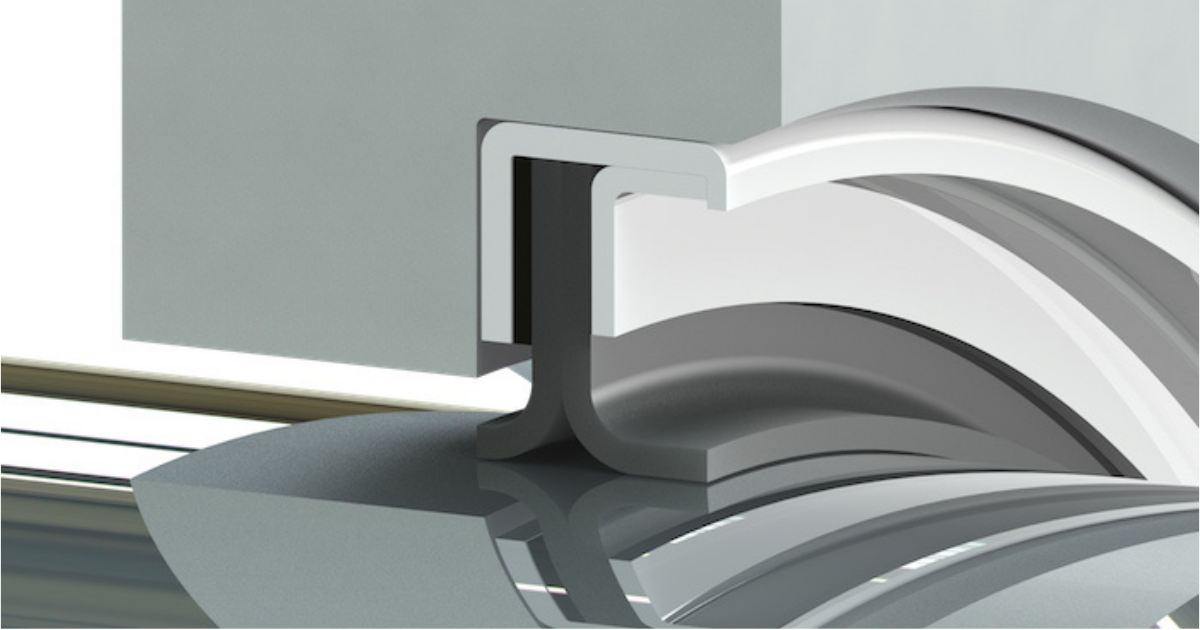
GYLON EPIX® features a hexagonal surface profile that provides the torque retention and blowout resistance of a thin gasket and the conformability of a thicker gasket. GYLON EPIX Style 3504 is a high performance, aluminosilicate microsphere filled PTFE sheet material designed for use in moderate concentrations of acids, and caustics, as well as hydrocarbons,
- January 08, 2020
Bacteria accumulation can ruin product and put consumer health at risk.
Bacteria accumulation is a serious issue in the food manufacturing industry - it can ruin product and put consumer health at risk.
While many know that Polytetrafluoroethylene (PTFE) is an excellent choice for use in diaphragms and gaskets, most do not realize that there exist varying grades of PTFE. Some lower cost PTFE offerings may contain an excessive volume of pores within their structure which can harbor organic contaminants such as bacteria.
To address this problem, a calendared manufacturing process is used. Calendared PTFE is a premium grade PTFE designed for use in aseptic applications requiring ultra-high purity standards. It is ideal for use in food, pharmaceuticals and a variety of clean markets.
Molded Diaphragm made from calendared PTFE Distinguished by an extremely low void content, calendared PTFE resists permeation and the accumulation of foreign matter, reducing the risk of harboring unwanted bacteria or residual media.
To achieve this, the unique manufacturing process orients the chains of PTFE in a lattice-like structure that reduces voids in the material and provides it with biaxial strength. This unique structure also delivers a very high flex life. When tested in an MIT Folding Endurance Tester, the flex life of calendared PTFE is four-times greater than conventional PTFE materials.
Unlike the skived process that is commonly used for PTFE manufacturing, the calendaring process produces uniform sheets of material with consistent physical properties. This gives calendared PTFE a renowned reputation for predictable performance and quality. The opposite is true for skived PTFE where variable properties lead to varying performance and reliability.
- December 13, 2019
Gylon Epix's patterned material provides enhanced compressibility for better sealing
Gaskets are ubiquitous components in a processing plant. Every flange, equipment joint and connection point will have some form of gasket to prevent fluids from compromising (i.e., leaking from) a process system. However, effective sealing can pose challenges. A new form of polytetrafluoroethylene (PTFE) gasket, Gylon Epix, already has successfully addressed a number of persistent problems at plants.
- December 05, 2019
Article re-posted with permission from Parker Hannifin Sealing & Shielding Team.
Original content can be found on Parker’s Website and was written by Ben Nudelman, Market Development Engineer, Chomerics Division.
Form-in-place EMI gaskets, also known as FIP EMI gaskets, is
- September 10, 2019
The search for the ideal Polytetrafluoroethylene (PTFE) gasket has been elusive. Competing applications and workplace variables have led to the creation of myriad solutions, yet none that has proven fully adaptable and appropriate for universal adoption.
Garlock Sealing Technologies considered this to be a critical yet entirely solvable shortcoming. And it is against this backdrop that in 2016, they set out to compile a comprehensive list of attributes for the ideal PTFE gasket — a wish list, as it were — in order to build a better gasket.
Working with a third-party survey development company, Garlock developed an exhaustive questionnaire that probed every aspect and functionality of PTFE gaskets, testing and adjusting the questions until they had a workable, finalized version.
Using this final questionnaire, Garlock conducted extensive interviews at 15 major chemical processor companies, speaking with 20 engineers responsible for process operations, projects, maintenance and reliability. The goal was simple: to discover the ideal characteristics and their relative importance that engineers sought in a PTFE gasket.
After several months of data collection, Garlock analyzed the feedback and noted the most popular responses:
- 28% of respondents said that they struggled with how different gaskets required different compressive loads and how to ensure that those gaskets had been installed properly
- 21% expressed frustration with the creep properties of PTFE gaskets
- 21% desired a gasket that seals with less compressive load
- 14% expressed frustration at the installation inconsistencies of their fitters
- 14% expressed frustration with leaking, especially after a successful installation and start-up
From those answers, Garlock drew the following conclusions, representing the most desirable and essential PTFE gasket characteristics:
- Seal: Seals easily
- Installation and assembly: Forgiving of poor installation or assembly practices
- Forgiving: Forgiving of poor flange conditions
- Retention: Maintains a seal after installation
- Flexible: Can be used in a broad range of services to avoid user confusion and reduce inventory
Introducing: GYLON EPIX
Garlock used this feedback in developing a next generation PTFE gasket — GYLON EPIX. Featuring a hexagonal surface profile, GYLON EPIX offers superior compressibility and sealing for use in chemical processing environments. Its enhanced surface profile performs as well or better than existing 1/16″ or 1/8″ gaskets, allowing end-users and distributors to consolidate inventory, lower the risk of using incorrect gasket thicknesses and reduce stocking costs.
GYLON EPIX checks off the most desirable gasket attributes:
- Installation and assembly: Even distribution of the bolt load over the contacted area of the gasket during the assembly process
- Retention: Retention of the bolt load administered at assembly
- Seal: Efficient translation of bolt load to sealing performance
- Forgiving: The ability to perform in imperfect flanges and installation conditions
GYLON EPIX with its raised, hexagonal profile allows it to perform the job of both traditional 1/16” and 1/8” gaskets. It accomplishes this by combining the bolt retention of the former with the forgiveness for bad flange conditions of the latter, a truly innovative feature for PTFE sheet gasketing.
- July 17, 2019
Recent gasket failures in flanged joints of High Density Polyethylene (HDPE) piping.
Problem
HDPE piping joints are typically thermal fusion welded joints, but flanges may also be used. When flanges are used, an HDPE flange adapter with a metal backing ring is fused to HDPE piping, as shown in Figure 1. The HDPE flange adapters are used to connect to other flanged fittings, such as valves, elbows, tees, etc., with gaskets inserted between the flanged fittings.
Incident Description
- April 16, 2019
The Dreaded Gasket Blowout Call
Have you ever received the dreaded 2 a.m. call from plant staff saying that things are at a standstill – production is down?
You arrive at the plant, walk through the parking lot, coffee in hand, and head to the locker room. When you come out on to the plant floor, there are several people staring at you with a look of panic on their faces as steam or process chemical sprays from a pipe flange.
Prognosis……gasket blowout.
You think to yourself “didn’t we just replace that gasket?”, or perhaps “we should have replaced it during the last shutdown but chose not to because of time constraints or cost cutting.”
If this scenario is new to you, you are lucky and you can go back to sleep… the 2 a.m. call was a wrong number. If it’s not new to you, this means you are most likely a Plant Supervisor, Maintenance Manager or Plant Personnel in some capacity.
Roll up your sleeves, grab your torque wrench and let’s get to work!
Gasket Lifespan
If I had a nickel for every time someone asked me, “How long will my gasket last?” I would be a rich man. As you can probably guess, “How long will my gasket last?” is a loaded question to which the practical, factual, and political answer is… an Application Engineer’s nightmare!
A gasket may last 5 years, or it could last 20 years. I cannot give you an exact date or lifespan of a gasket; however I can give you some insight into factors that will give your gasket the best chance at a long and prosperous life between the flanges.