o-ring
-
February 23, 2017
Article re-posted with permission from Parker Hannifin Sealing & Shielding Team. Original content can be found on Parker’s Blog.
This is the third in a series of video blog posts showing viewers how to install an O-ring.
In December, we discussed how to install an O-ring on a face seal gland and in January we showed you how to install an O-Ring in a standard female gland. In today's post, we'll look at the best way to install an O-ring on a standard male gland.
[embed]https://www.youtube.com/watch?v=QcJBVQvTvhw[/embed]
Typically when installing an O-ring into a standard male gland, the process is pretty straight forward. Guide the O-ring along the shaft until you reach the gland to where it snaps in place. Sounds simple enough, but here's some tips on exactly what to do, and not to do.
-
February 09, 2017
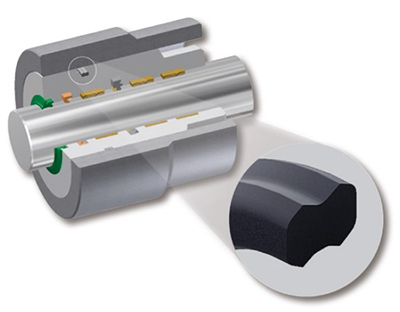
O-ring/back-up ring combinations have long been considered the industry standard for static applications at high pressures. In field use, however, they may show weaknesses with respect to their installation and operation in the application. Standard O-rings are often prone to twisting, while back-up rings are oftentimes not installed in the proper position or damaged during installation. Furthermore, this sealing combination may exhibit deficits when exposed to pulsating pressures and dirt. Parker has developed the HS radial seal profile as a viable alternative to to conventionally used O-ring/back-up ring combinations for static sealing applications at high pressures.
The robust symmetrical seal geometry and use of particularly extrusion-resistant Parker polyurethane compounds not only simplifies installation but also enhances the sealing effect in pulsating pressure conditions. As a result, service life is significantly extended.
-
January 26, 2017
Article re-posted with permission from Parker Hannifin Sealing & Shielding Team. Original content can be found on Parker’s Blog.
This is the second in a series of video blog posts telling viewers