o-ring
-
May 31, 2018
Article re-posted with permission from Parker Hannifin Sealing & Shielding Team.
Original content can be found on Parker’s Blog.
TetraSeal: An Alternate Sealing Solution When an O-Ring Isn't Working
Our applications engineering team takes more than a few calls each month where the O-ring is leaking, either immediately or after just a short time in service. Once we drill down to the details, we learn the failure mode is an improperly sized groove and O-ring. It isn’t all that uncommon for a groove to be cut in a flange and a novice designer learns the hard way that standard O-rings cannot fit in just any groove geometry. For hardware that has already been machined, frustration ensues as the caller learns the O-ring solution requires tooling. Tooling can have a lead time of at least a month to cut and can cost thousands of dollars. Parker offers a TetraSeal® solution, which often does not require tooling and can be made of many of the same materials used for O-rings.
Benefits of TetraSeals
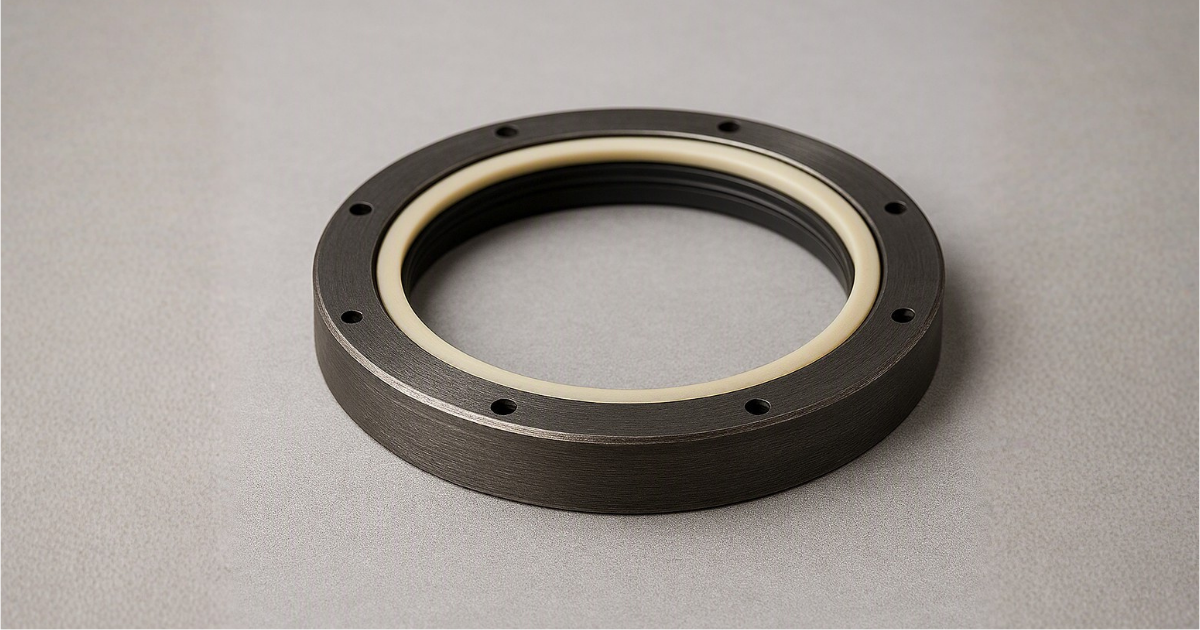
The TetraSeal is a circular precision-cut seal with a square cross-section. Unlike O-rings which require a unique mold for each material family and size, TetraSeals are extruded, cured and machine cut to the target thickness. Our manufacturing facilities in both Spartanburg, South Carolina and Goshen, Indiana are tooled in a variety of interchangeable extrusion dies, making this type of seal an easily sourced seal solution without the lead time and cost of a custom molded O-ring.
-
April 24, 2018
Article re-posted with permission from Parker Hannifin Sealing & Shielding Team.
Original content can be found on Parker’s Blog.
We receive many requests from customers asking for recommendations on how to retain seals in an application. One of the most popular "quick fixes" is to apply liberal amounts of adhesive to a standard O-ring type product without respect to groove shape or sealing function. However, Parker OES provides a wide array of sealing technologies, offering innovative solutions to accommodate the challenging and vast sealing needs of our customers.
Replacing RTV with Pre-Applied PSA
A customer had been using a standard O-ring product on an outdoor electronic device. This part was sealing the external edge of the enclosure and meant to keep out water and dust. The enclosure was plastic injection molded so this extreme edge had irregular geometry to accommodate the molding process. The original proposal was to shove O-ring cord in place and adhere it down with RTV (Room Temperature Vulcanization) so that it did not fall out during assembly. This left a rust colored stripe exposed on a consumer device due to fitment issues. Parker’s proposal was to replace the O-ring cord with a custom hollow extrusion that fit the available space and allowed complete closure, thus not exposing the seal to be visible. The RTV process was replaced with PSA (Pressure Sensitive Adhesive) that was preassembled to the seal and allowed for quick and clean placement during assembly and retention for any maintenance needed.
-
March 13, 2018
Gallagher recently published its Failure Modes of Elastomers in the Semiconductor Industry White Paper, now available for download on our site. This white paper discusses common issues that occur with elastomer seals in the semiconductor industry. The excerpt below is the third section of our new white paper, discussing O-Ring Stretch, Chemical Attack, Plasma Cracking, and Permeation. To download the entire white paper, visit our Resources Page, or click on the image to the right.
Failure Modes of Elastomers in the Semiconductor Industry
High performance elastomers are found in many applications in the semiconductor industry (see paper titled Perfluoroelastomers in the Semiconductor Industry). Though perfluoroelastomer (FFKM) seals are formulated to meet the highest performance requirements of integrated circuit (chip) manufacturers, even these elastomers can’t solve every sealing application nor will they last forever in service. Additionally, end users need to understand subtle performance differences between perfluoroelastomers in the same product line. For example, one product may be better at minimizing particle generation while another may be better for high temperature services.
-
January 23, 2018
O-Rings continue to be the most widely utilized sealing product. While the ‘Donut’ shaped profile has by and large been kept intact since their inception, continued elastomeric development has pushed o-ring temperature and chemical compatibility to limits unimaginable several decades ago.
Typically, O-Rings fail due to adverse effects of a number of factors, from improper installation and lubrication to incorrect size and design. The collection of videos below will help you minimize installation errors that may lead to failure (be sure to bookmark this page for future reference).
How To Install an O-Ring - Standard Male Gland
[embed]https://youtu.be/QcJBVQvTvhw[/embed]
-
November 16, 2017
[embed]https://www.youtube.com/watch?v=dAG0ymNGaHE[/embed]
Lubrication of O-rings is extremely important. The greatest benefit of using a lubricant is typically obtained during installation.
Using a lubricant is going to decrease the surface friction of the O-ring helping
-
July 11, 2017
The face seal design chart below explains the hardware dimensions to use for an O-ring seal when the groove is cut into a flat surface.
Systems Which Contain Internal Pressure
For designing systems which contain internal pressure, like the example below, the groove's outside diameter (OD) is primary, and the groove's width then determines the inside diameter.
-
June 13, 2017
Extrusion and nibbling of the O-ring is a primary cause of seal failure in dynamic applications such as hydraulic rod and piston seals. This form of failure may also be found from time to time in static applications subject to high pressure pulsing which causes the clearance gap of the mating flanges to open and close, trapping the O-ring between the mating surfaces.
Watch the video below from Parker's O-Ring eHandbook, showing how extrusion & nibbling can happen.
-
April 20, 2017
Article re-posted with permission from Parker Hannifin Sealing & Shielding Team. Original content can be found on Parker’s Blog.
This video provides instructions on how to properly install and uninstall a Parker TechSeal's hollow O-ring. Although appearing simple, the installation process of a hollow O-ring
-
March 28, 2017
Article re-posted with permission from Parker Hannifin Sealing & Shielding Team. Original content can be found on Parker’s Blog.
Dovetail grooves are a great mechanism for holding O-rings in place.