spring energized seals
- December 15, 2025
Why an Extrusion Gap is Important
“How much pressure can this seal handle?”
The answer to this question depends on a number of parameters and conditions. But the principle limiting factor in the pressure handling of any seal system is the extrusion gap.
Commonly referred to as the “E-Gap,” the extrusion gap is one of the most critical design aspects in any high-pressure application. Seal design, type, and material are all influenced by the extrusion gap and the desired pressure handling capability.
What exactly is an extrusion gap, and why is it so important in the successful design of a sealing system? Let’s find out.
The Basics: What is an Extrusion Gap?
In terms of sealing systems, the extrusion gap is defined as the clearance between the hardware components.
In a piston configuration, this would be the clearance between the piston and bore. In a rod configuration, this is the clearance between the rod and housing it’s passing through.
The extrusion gap can be expressed in terms of radial or diametral clearance, which can lead to some confusion. Our partners at Eclipse define the E-Gap by stating it as the radial clearance. The radial clearance is equal to the diametral clearance divided by two.
It’s important to note that while hardware components might be machined to have a specified clearance, this gap might not be perfectly realized or maintained.
- July 01, 2025
What is a Spring Energized PTFE Seal?
Spring energized PTFE seals perform reliably in a variety of applications where conventional elastomeric seals may fail.
PTFE
- June 01, 2025
Spring-Energized Metal Seals Help Protect Equipment
Spring-energized metal seals provide numerous advantages in oil and gas applications, including but not limited to MWD and LWD tools, couplings, subsea compressors, enclosures/vessels, christmas trees, electronic submersible pumps and flowmeters. Extreme operating pressures and temperatures, together with more difficult resource recovery, zero tolerance for failure and environmental concerns, are placing unprecedented demands on this equipment.
- May 28, 2025
Here we’ll discuss the basic functionality and design principles of spring energized seals and discover why one might be the perfect sealing solution in your application. This article was written by GFS supplier/partner Eclipse Engineering.
Spring energized PTFE seals perform reliably in a variety of applications where conventional elastomeric seals fail due to chemical attack, extreme heat or cold, friction, extrusion or compression set.
- May 29, 2024
Metal Seals for Critical Valve Applications
In a typical oil refinery or chemical processing plant,
- September 15, 2021
With the marijuana and cannabis industry expected to take in nearly $24 billion by the end of in 2021, and more than $40 billion by 2025, the market is primed for innovation in production volume and technology.
The growth in popularity of vaporizers, infused edibles, and topical cannabis products means the demand for cannabis oil extraction is a fast multiplying industry.
The two primary means for oil extraction is via petroleum based solvents such as butane or propane, or by supercritical
- July 16, 2021
As the operating parameters of industrial technologies and manufacturing processes get more extreme, the need for optimal sealing solutions become that much more important.
Elevated temperatures and pressures, higher speeds, extreme environments, faster gas decompression, and aggressive medias all make sealing more critical. This extends right across static, reciprocating, rotary, and oscillating applications.
This challenge has been met very effectively
- October 20, 2020
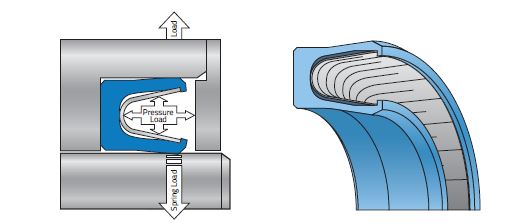
When considering polymer jacketed seals — especially PTFE-based products — some form of energizer is typically required. These types of seals are usually specified to operate both in very high pressures, low pressures, or even in a vacuum.
At certain pressures (typically above 100psi), the system pressure will energize the seal and prevent leakage. But at low pressures, additional energy is required to force the jacket material to mate with the hardware.
The solution to this is to add a spring to the seal. The spring provides the needed sealing-energy to prevent leakage at low media pressures.
When considering a high pressure-application, there are start/stop conditions where the system is at low pressure. If the seal allows some amount of leakage at low pressure, it becomes possible for that leakage level to increase once as the pressure builds.
This phenomenon is called “blow-by.” Once it occurs in a system, it’s difficult to get the seal to seat and seal correctly.
Canted Coil Spring Energizer
There are several types of energizers to consider when specifying a seal. These can be as simple as an O-Ring or some other elastomer.
- November 12, 2019
Springs are an integral part of all sealing systems. A simple air cylinder has O-rings to seal in the air, and the O-ring exhibits spring-like qualities to ensure a good seal over a broad temperature range.
But what are the different types of springs and materials in sealing systems? And how do you choose the best for your application?
- February 28, 2019
Being commodity items, U-Cups are readily available in a number of materials and can be found on-the-shelf from multiple distributors and manufacturers in many standard sizes.
Named for the shape of their cross-section, a U-Cup’s design will be pressure energized increasing sealing effectiveness when compared to a standard O-Ring.
This means as pressure increases, the sealing lips are continually forced into the mating hardware surface, ensuring good contact at all times.
The simple and easily moldable design is an effective sealing solution to many systems in both hydraulic and pneumatic applications. Modifications in lip thickness and inclusion of an O-Ring Energizer can tailor sealing loads and wear life to specific situations.
A key advantage to an elastomeric U-Cup is the relatively small and simple hardware space needed. Because of their flexible compounds, most U-Cups can be installed in a solid gland configuration.
A basic ID or OD groove is all you need for proper seal retention. Plus, no special tools or considerations need to be taken for correct installation.
U-Cups are available in many of the same compounds as standard O-Rings such as Nitrile, Fluorocarbon, and EPDM, but polyurethanes may be the most common material.
Urethane provides a good combination of elasticity/pliability and toughness. Therefore, it exhibits good sealing characteristics as well as, durability and wear resistance.
These desirable qualities make U-Cups an optimal solution for many sealing systems across multiple industries and they can be found in countless standard products. But Eclipse is approached many times a year with customers pushing the limits of standard U-Cups and in need of better solutions.
The Client's Issue
Eclipse was approached by a leading pneumatic cylinder manufacturing seeking a sealing solution for a unique application.
While U-Cups typically provide optimal sealing performance in pneumatic cylinders, this application presented a difficult challenge.
The air cylinder was to be used as an actuator for a latch on a large industrial oven. While pressures, speeds, and cycle times were nothing out of the ordinary, the temperature at which it had to operate at was — a continuous 500°F.