Blog
- September 10, 2024
How to use Rotating Shaft Seals
Answering common questions about rotating shaft seals
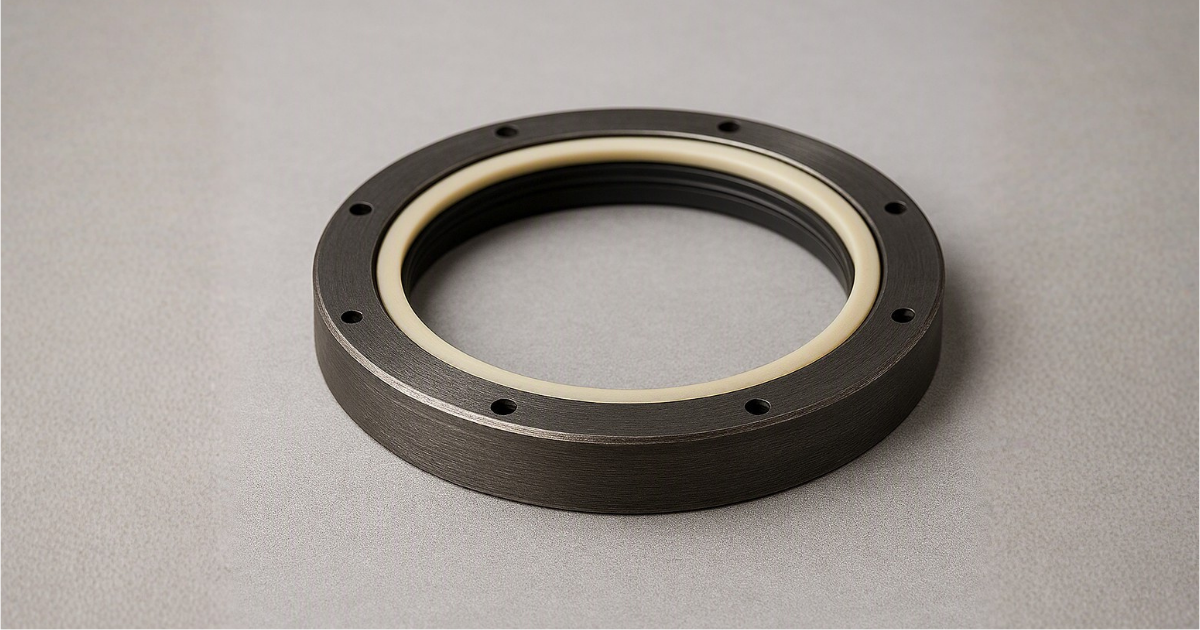
Rotating shaft seals can be found in virtually every facet of daily lives—household appliances, cars and trucks and across industries. Though often treated as a commodity product, their failure can result in costly downtime and lost productivity. Despite their use in countless applications, many still have basic questions about how to use them. Here are some frequently asked questions.
What
- September 05, 2024
Gallagher Fluid Seals is a Parker Distributor and is proud to be one of the few premier distributors to qualify as a “Parker Seal Technology Center (STC)”.
How Maintance Can Stop Hydraulic System Failure
As you set out to reduce hydraulic system failure, it’s important to recognize sources of contamination as part of your maintenance program.
Our partners at Parker, long-time suppliers of o-rings to Gallagher, are experts in both seals and hydraulic systems.
- September 03, 2024
Types of Spring Energized Seal Lips
Spring Energized Seals can be found in all kinds of applications across the spectrum of industries and sectors. While the pros and cons of the different spring types contained in the seal are often discussed, the style of sealing lips can also have a significant impact on performance.
Every spring type has at least 4 standard lip style options, so choosing the right style for your application is critical. There are a number of design factors that need
- August 29, 2024
The Basics of Braided Packing / Compression Packing
It’s highly likely that, at some point or another, you have seen braided packing, also known as compression packing, in or out of its “natural environment.” Braided packing looks like rope and is cut into rings that wrap around a rod. While packing used to be available in fairly limited styles, the mechanical packing industry has expanded over time, resulting in braided packing that is available in everything from flexible graphite to fiberglass
- August 27, 2024
High-Performance Material Offers Alternative to PTFE: Better Properties At Lower Costs
Freudenberg Sealing Technologies, global market leader for sophisticated and innovative applications in sealing technology and electromobility, offers a real alternative to traditional PTFE solutions with its innovative high-performance “98 AU 30500” material. First customers in the construction machinery sector are already impressed by the use of the hydrolysis-resistant high-performance polyurethane.
- August 23, 2024
Gallagher Fluid Seals is a Parker Distributor and is proud to be one of the few premier distributors to qualify as a “Parker Seal Technology Center (STC)”.
Sealing Selection for Hydrogen Applications
When considering the vast array of hydrogen applications, several critical requirements for sealing systems emerge. These requirements can vary in importance depending on the specific application. Key factors include:
- Low permeation and/or leakage
- August 20, 2024
Versatile and easy-to-install, this 100% ePTFE sealing cord is a cost-effective solution for large steel flanges in general-use applications.
Joint Sealant, the first form-in-place gasket, was invented by Gore more than 40 years ago. It is a time-tested sealing solution for steel flanges with large diameters, rectangular or irregular shapes, and rough or pitted surfaces. When compressed, this soft, conformable cord forms a thin yet strong seal. It can also seal applications where available
- August 13, 2024
Gallagher Fluid Seals is a Parker Distributor and is proud to be one of the few premier distributors to qualify as a “Parker Seal Technology Center (STC)”.
How to Read a Rubber Test Report
The Most Common Rubber Test Report Misunderstandings
It's a common misinterpretation: an engineer, buyer, quality analyst, or someone else entirely looks at a rubber test report, reads the numbers on it, and comes up with the wrong conclusion. Pass / fail limits and
- August 09, 2024
Optimizing Seal Selection: From O-Rings to Press-In-Place Seals
What is the right seal for my application? The question is simple, but the answer may not be as straightforward as you would expect.
The inputs for selecting the proper seal type are complex.
- Is it a static or dynamic seal?
- Is it a face seal or radial seal?
- How is the seal installed during assembly?
- What options are available for seal retention?
- Is there room in the mating hardware