Blog
- December 08, 2025
Parker's ProTech™ Bearing Isolator Seals
- December 04, 2025
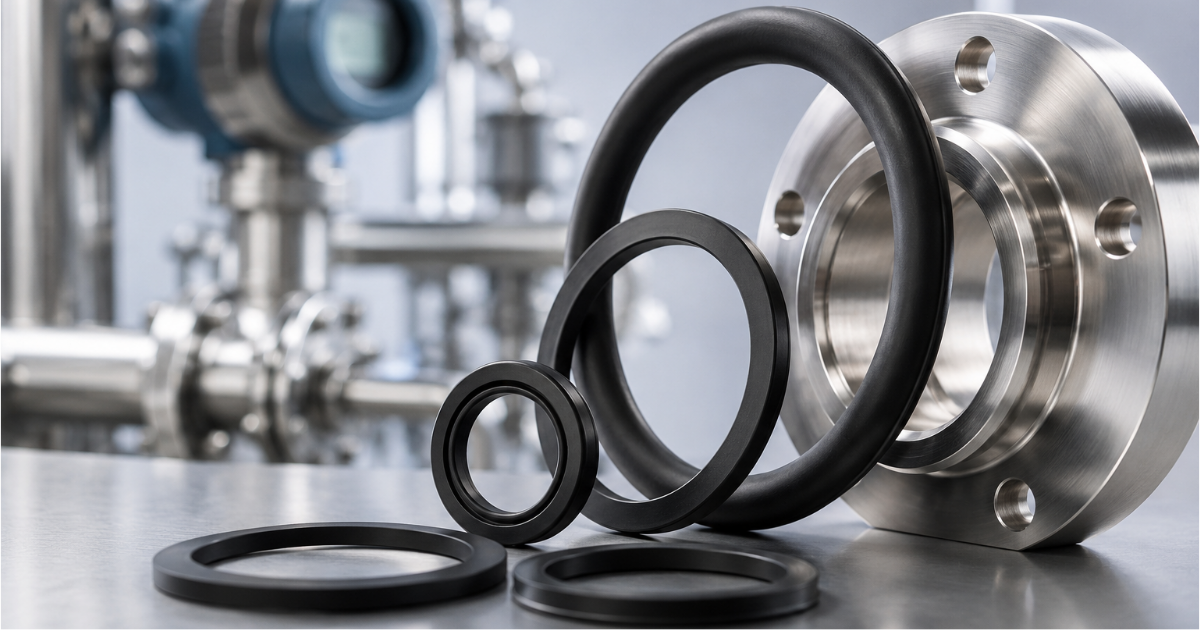
Why Swivel Arm Repairs Fail: The Hidden Role of Flange Seal Engineering
At LNG export and import terminals, swivel arms are among the most relied-on pieces of equipment during loading and unloading. When they operate as intended, they enable smooth movement, controlled flow, and safe transfer of product. When they don’t, downtime adds up fast.
Yet even with stringent maintenance schedules and skilled repair teams, swivel
- December 02, 2025
Vesconite Rudder Bearings Reduce Wear
Brazil, Paraguay and Argentina - The waters of the Parana River tend to be wide and deep, with significant suspended debris and sand. Due to these abrasive conditions, rudder bearings on tug boats operating on the river are susceptible to rapid wear. The result is frequent dry docking for repairs. In response, Vesconite bushings have been successfully fitted to 20 tug boats working the Parana River. The combination of exceptionally low wear, self-lubrication and easy installation makes it an ideal material for this application.
Vesconite for Marine Applications
Vesconite, and Vesconite Hilube in particular, are ideal for the submerged and corrosive conditions of the marine industry. Suited to both dry and underwater applications, Vesconite’s internal lubricants allow for prolonged life where the setting is characterized by irregular greasing schedules, or no greasing at all. Unlike most bearing materials, Vesconite offers long wear life and a high load-bearing capacity with no distortion or delamination, despite the wet and abrasive working environment. Vesconite is easily removed and refitted, saving in costly downtime.
- November 25, 2025
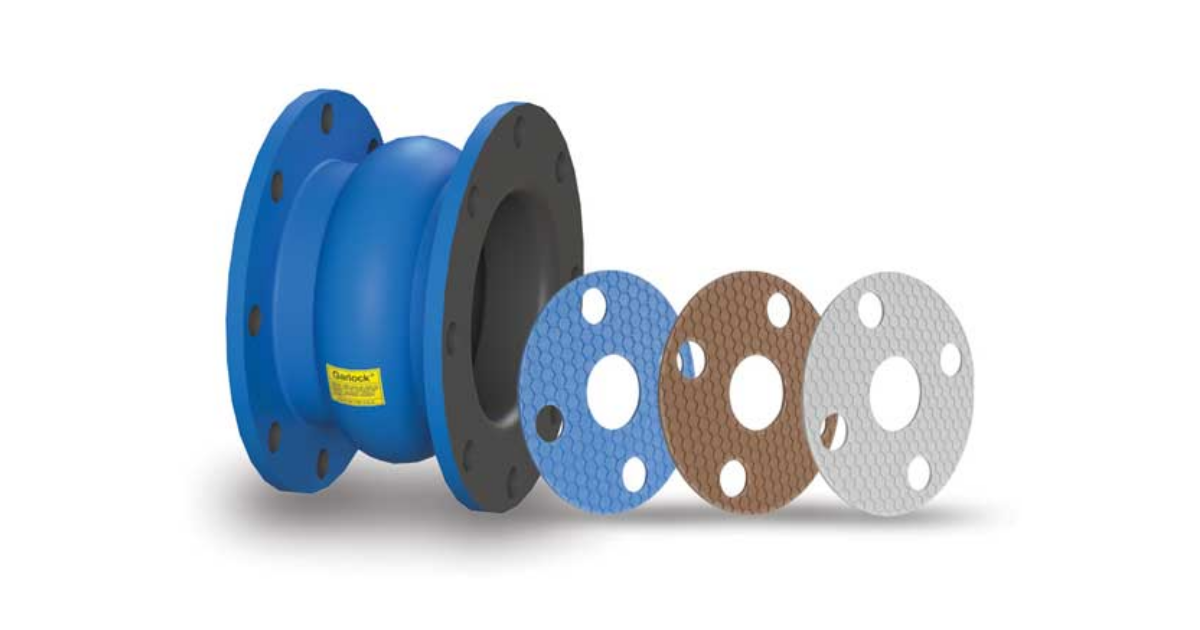
Garlock Style 215 Helps Steel Products Manufacturer With Harsh Acids
Garlock Style 215 Expansion Joints are PTFE concentric spool-type flexible couplings that are designed to reduce noise and compensate for expansion, contraction, and minor piping misalignment in chemical processing, air conditioning, and heating systems.
The complete assembly includes a fluorocarbon resin PTFE body, electroless nickle-plated ductile iron flanges, polyethylene-covered restriction zinc plated bolts, and stainless steel corrosion-resistant reinforcing rings.
Case Study
INDUSTRY
Primary Metals
CUSTOMER
South American manufacturer of flat and long steel products
BACKGROUND
Construction of two new facilities including a hot rolling mill.
CHALLENGES FACED
The plant was in need of expansion joints that could handle chemicals on their pickling lines. Pickling is a metal surface treatment used to remove impurities, such as stains, inorganic contaminants, rust or scale from ferrous metals. A solution called pickle liquor, which contains strong acids, is used to remove the surface impurities. It is commonly used to clean steel in various steel making processes. The line required an expansion joint with a PTFE tube to handle the pickle liquor which included hydrochloric and sulfuric acid, but a very short overall length for installation.
- November 24, 2025
Freudenberg Sets New Standards With Innovative BPAF-Free Sealing Solutions
Weinheim, November 24, 2025. In accordance with EU Directive 2024/3190, a Europe-wide ban on the use of bisphenol A (BPA) and its derivatives took effect on January 20, 2025. This decree applies to all industrial companies that produce, market or use materials that come into contact with food. The ban is based on comprehensive studies
- November 20, 2025
Fluid Power Seals for Pneumatic Cylinder Systems
Fluid power seals used in pneumatic cylinder systems represent some of the most overlooked, yet vital components in its construction and operation. Without these rubber seals – or if using inferior seals – the friction and leakage created by the process of using a pneumatic cylinder application could cause the equipment to catastrophically fail, risking severe damage and injury, and requiring great cost to repair or replace.
Gallagher Fluid Seals' partner, Precision Associates, has innovated to create our own unique and patented compounds for rubber pneumatic piston seals—suitable for all sorts of pneumatic applications. These U-Cups are designed to function with vastly lower breakaway and operating friction than any similar product in the marketplace.
What Are Pneumatic Cylinder Systems?
Utilizing compressed gas as a power source, mechanical pneumatic cylinders produce a reciprocating linear motion force. Like hydraulic cylinders, this force drives a piston in the required direction and the piston is usually a disc or cylinder. The corresponding rod transfers the force it creates to the object requiring movement. Engineers often choose pneumatic cylinders over other methods due to pneumatics being quieter, producing less waste, and requiring significantly less amounts of space for fluid storage.
Pneumatic cylinders can vary in configuration, but generally fit into one of three specific categories:
- November 18, 2025
Process Stability: Extrusion Line Vulcanizing With Molten Salt
The core of the 36-meter extrusion line is a 19-meter salt bath. At the start of the production line, two mobile extruders run on specially installed rails as needed. This allows for a quick conversion of the production environment – from delicate millimeter-scale geometries to large-format sealing cross-sections. The extruded profile is vulcanized
- November 14, 2025
Cased Lip Seals vs. Spring-Energized Seals: Choosing the Right Sealing Solution
In demanding industrial environments, selecting the right seal design can determine whether equipment operates efficiently or fails prematurely. Among the many sealing options available, cased lip seals and spring-energized seals are two high-performance designs frequently used in rotating,
- November 11, 2025
Understanding Secondary Sealing Elements in Mechanical Seals
- November 06, 2025
Vesconite Bearings confirms PFAS-free status of long-standing standard material
Vesconite Bearings is pleased to confirm that its long-established Standard Vesconite bearing material is completely free of PFAS (per- and polyfluoroalkyl substances) and has been since its development in 1969.
This includes the absence of PTFE (polytetrafluoroethylene), a commonly used fluoropolymer that is now increasingly targeted under international environmental legislation due to its persistence in the
Latest Blog Posts