Blog
- January 14, 2026
Celebrating 70 Years of Gallagher Fluid Seals
On January 16, 2026, Gallagher Fluid Seals proudly marks 70 years in business—a milestone made possible by generations of leadership, innovation, and an unwavering commitment to our customers.
Watch the video below to hear directly from our leadership and learn more about the 70- year journey of Gallagher Fluid Seals.
- January 12, 2026
Friction Fit Retention Sealing For Low-Closure Force Applications
Parker’s hollow cross-section, low-closure force seals reduce bolt loading and flange requirements when sealing enclosures and boxes. These spliced hollow rings are used in telecommunications, electronics, semiconductor, general industrial, aerospace, military and automotive applications.This reduced closure force is achieved by changing - January 08, 2026
Sealing Heavy-Duty Equipment
The seals and the hydraulic systems of any piece of mining, construction, agricultural or other heavy industry equipment operate under extreme conditions. Variable temperatures, aggressive hydraulic oils, dust and extended periods of operation place seals and their tribological systems under continuous duress. A new generation of material, 94 AU 30000, expands the boundaries for polyurethane use. This innovative compound can be used in standard cylinder applications where higher pressures, larger extrusion gaps, reduced internal friction, improved hydrolysis resistance and compatibility with bio fluids, among other factors, are important. DMRW2 hydraulic wipers made from 94 AU 30000 and sheet metal and the availability of this polyurethane as part of Freudenberg Sealing Technologies’ Xpress rapid replacement part service are applications discussed in the following article.
Today’s extreme environmental climates place extreme demands on the material and structure of the hydraulic seals used to maintain the performance and operation of heavy-duty equipment. The excavators, tractors, backhoes and tunnel boring machines that grind through the earth every day must work harder, longer, cleaner and more cost efficiently than ever to feed the plant, build its infrastructure and harvest its natural resources.
Sealing requirements for these machines must now include high values for tensile strength and elongation at break, resistance to oils and ozone, high elasticity and abrasion resistance. Polyurethane materials (PU) have traditionally met these industrial requirements. In comparison with elastomers, PU has a four times greater capacity for mechanical resistance, as well as outstanding resistance to ozone. At the same time, it stands up well to the stresses of mineral-based fluids.
- January 06, 2026
Carbon-Graphite Blistering in Mechanical Seal Faces
- December 23, 2025
Kalrez® Bonded Door Seals
Bonded door seals for gate valves and slit valve door seal applications provide improved sealing performance versus conventional O-rings by reducing particle generation, extending seal life, and minimizing replacement time during preventive maintenance.
DuPont™ Kalrez® bonded door seals are designed for easy installation and low particle generation. They combine a custom seal design and proprietary
- December 18, 2025
Vesconite Rudder Bearings Meet Stringent Global Class-Society Standards
- December 15, 2025
Why an Extrusion Gap is Important
“How much pressure can this seal handle?”
The answer to this question depends on a number of parameters and conditions. But the principle limiting factor in the pressure handling of any seal system is the extrusion gap.
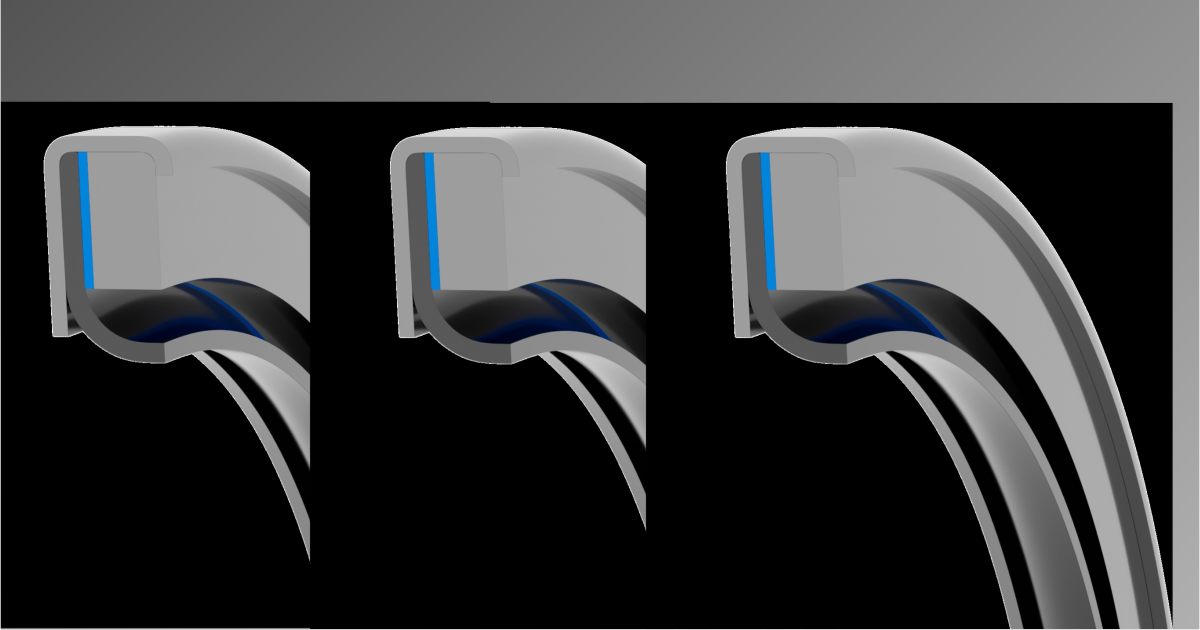
Commonly referred to as the “E-Gap,” the extrusion gap is one of the most critical design aspects in any high-pressure application. Seal design, type, and material are all influenced by the extrusion gap and the desired pressure handling capability.
What exactly is an extrusion gap, and why is it so important in the successful design of a sealing system? Let’s find out.
The Basics: What is an Extrusion Gap?
In terms of sealing systems, the extrusion gap is defined as the clearance between the hardware components.
In a piston configuration, this would be the clearance between the piston and bore. In a rod configuration, this is the clearance between the rod and housing it’s passing through.
The extrusion gap can be expressed in terms of radial or diametral clearance, which can lead to some confusion. Our partners at Eclipse define the E-Gap by stating it as the radial clearance. The radial clearance is equal to the diametral clearance divided by two.
It’s important to note that while hardware components might be machined to have a specified clearance, this gap might not be perfectly realized or maintained.
- December 11, 2025
Article re-posted with permission from Parker Hannifin Sealing & Shielding Team.
Original content can be found on Parker’s Blog.O-Ring Selection Made Easy with the Parker O-Ring Selector
Two things are equally important for the reliable performance of an O-Ring seal: the right size and the right material. Parker’s O-Ring Selector is an engineering tool that enables users to make the right material and size selections easily, quickly and reliably – in a single application. The accuracy of the results ensures the desired performance of the O-Ring in the subsequent application. This is primarily based on the fact that both functionalities – the material selection and the O-Ring size calculation – are closely interlinked. This achieves a new quality in calculating the total sealing system.
Overview of the O-Ring Selector
The Parker O-Ring Selector is divided into three main sections:
- Service Conditions & Material Selector
- Size Selector
- Notes
The Service Conditions & Material Selector section is focused on mapping the material-related application conditions. Entering the operating temperature range, the desired polymer family and/or material hardness will take the user to the suitable material selection. The Advanced Material Selector enables experienced users to specify the operating conditions in even greater detail. Here the medium to be sealed can be selected from a database containing 2,500 media. In addition, a search for required approvals and conformities can be run.
- December 08, 2025
Parker's ProTech™ Bearing Isolator Seals
- December 04, 2025
Why Swivel Arm Repairs Fail: The Hidden Role of Flange Seal Engineering
At LNG export and import terminals, swivel arms are among the most relied-on pieces of equipment during loading and unloading. When they operate as intended, they enable smooth movement, controlled flow, and safe transfer of product. When they don’t, downtime adds up fast.
Yet even with stringent maintenance schedules and skilled repair teams, swivel
Latest Blog Posts