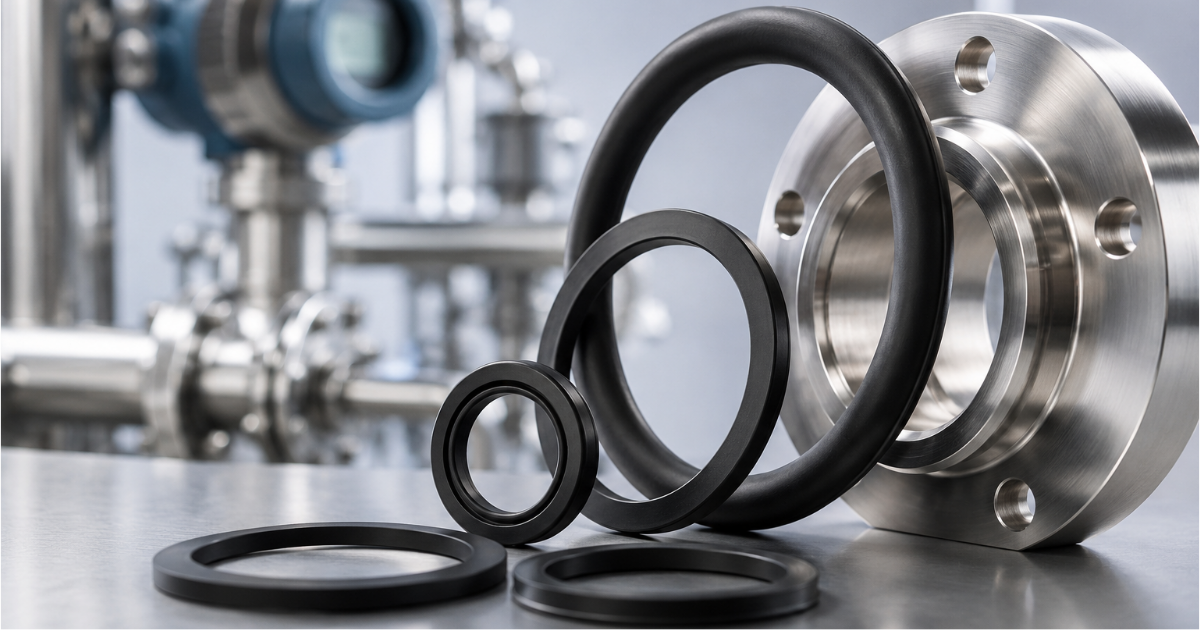
O-rings are a critical component of equipment, machinery, and a variety of other applications. Shaped like a donut, the O-Ring can plays a significant role in industries across the globe. Most often, they are made from elastomers. They are designed to prevent fluid and gas from leaking around mating surfaces. Leakage on mating surfaces can cause serious damage and disrupt machining processes. That's why O-Rings are vitally important as they can effectively prevent this from happening. O-Rings can
elastomeric seals
- October 16, 2024
AMS3678 Certified PTFE Materials
Parker is now offering PTFE compounds certified to AMS3678 standards.
This certification ensures that their materials meet the rigorous requirements essential for aerospace applications. Available for all PTFE seals, these certified materials are engineered to deliver superior performance, reliability and longevity.
Some compounds currently
- September 20, 2024
PFAS in Seals and O-Rings
The family of per- and polyfluoroalkyl substances (PFAS) is facing intense scrutiny. A reporting rule will take effect in the United States in 2026, while Europe has actually been considering a sweeping, cross-industry ban on these substances since early last year. The implications of such a ban on fluoropolymers would be particularly critical, as a discontinuation of these high-performance materials would drastically impact many industries. But what kinds of challenges
- August 27, 2024
High-Performance Material Offers Alternative to PTFE: Better Properties At Lower Costs
Freudenberg Sealing Technologies, global market leader for sophisticated and innovative applications in sealing technology and electromobility, offers a real alternative to traditional PTFE solutions with its innovative high-performance “98 AU 30500” material. First customers in the construction machinery sector are already impressed by the use of the hydrolysis-resistant high-performance polyurethane.
- June 25, 2024
Selection Requirements for Elastomeric Seals
Gallagher Fluid Seals is a Tier 1 DuPont™ Kalrez® distributor and we are proud of our longtime partnership with DuPont®, having specified thousands of perfluoroelastomer parts over the past few decades.
DuPont™ is at the forefront of perfluoroelastomer development, creating elastomers with properties that can help
- June 20, 2024
Gallagher Fluid Seals is a Parker Distributor and is proud to be one of the few premier distributors to qualify as a “Parker Seal Technology Center (STC)”.
The emergence of degradable and dissolvable materials is providing oilfield service companies an opportunity to increase efficiencies and cut costs in the oilfield by simplifying well completions. These materials replace their conventional metallic and polymeric counterparts in completion tools, but eventually break
- December 18, 2023
Designing with inflatable seals for the medical industry
Seals are central parts of the design of medical equipment with moveable, interlocking parts that must be secured for sanitary, thermal, or radioactive reasons.
Designing with inflatable seals requires the inclusion of a source of compressed gas, which is used to inflate seals in the medical device industry and it is often already available on the plant floor, in a laboratory, or medical environment. It is also possible to inflate with liquids rather than gas in demanding applications, and water would be an acceptable inflation media in this sector, although not common. For some low-temperature applications, a seal may be inflated with a blend of glycerine and water.
Designing with inflatable seals
Seals used on doors and openings should be part of the early phases of product design. In some cases, contact seals may be effective, but they often require substantial force be applied to load the seal, which impacts product design and increases manufacturing cost. Inflatable seals enable more cost-effective machinery fabrication for two reasons:
- Inflatable seals are more forgiving because the seal can inflate to close a gap between structural members and achieve equal sealing pressure around the flange as long if the gap falls within a broad tolerance. An inflatable seal will work whether the gap spans 3mm or 10mm, for instance. A compression seal or other contact seal will not be effective unless the seal and flange contact each other with great precision, which can be difficult to achieve on new equipment. Even a robust and precision-manufactured machine with well-designed flanges will lose some of its geometric integrity as hinges and other components deform or bend over years of use. Throughout the course of the equipment lifecycle, a contact seal may become problematic and exhibit leakage.
- Inflatable seals enable lighter and more affordable methods of equipment fabrication. The force exerted on the chassis of a piece of equipment means doors and related components must be thicker, and perhaps machined instead of welded. These components are typically made of stainless steel, and inflatable seals might be attractive due to lowered material costs.
Which equipment needs inflatable seals?
- Isolators — where a leak-tight enclosure can be critical for environmental health protection due to hazardous substances or processes. — can secure glove boxes, access gates, transfer systems and filtration systems that handle toxic or sterile components.
- Sterilizers — which may rely on heat, chemicals, irradiation, or filtration — may be suitable for desktop autoclave sterilizers, sterilizing tabletop autoclaves and static air depyrogenation sterilizers.
- Dryers and freeze dryers - used to sterilize everything from machine components to glassware.
- Material handling functions - to raise, lower, or grasp objects.
- August 29, 2023
Gallagher Fluid Seals is a Parker Distributor is proud to be proud to be one of the few premier distributors to qualify as a “Parker Seal Technology Center (STC)”.
Article re-posted with permission from Parker Hannifin Sealing & Shielding Team.
Original content can be found on Parker’s Website
- August 18, 2023
The world has entered a pivotal moment in water treatment, and the challenges continue to worsen as municipalities grapple with the risk of encountering premature failure in elastomeric gaskets. Such a risk brings up several problems, including reduced efficiency, sudden equipment failure, costly maintenance and downtime, and perhaps worst of all — contamination.
Prior to 2013, gasketing products were not subject to the NSF61 (Drinking Water System Components – Health Effects) standard, leaving
- July 06, 2023
Seals Help Keep Protective Gas in Place
In many countries, the expansion of renewable energy is an imperative. To ensure the energy transition’s success, it will be crucial to transport the electricity generated in hydroelectric plants and in solar and wind farms to consumers with minimal energy loss. New electric power lines are now expected to supplement those already in existence. After all, more energy from windy coastlines has to travel deep into the interior. Distribution stations and
Latest Blog Posts