parker
- December 27, 2018
Article re-posted with permission from Parker Hannifin Hydraulics Team.
Original content can be found on Parker’s Blog.
Most people enjoy theme parks as a place to get away from work, but for those in the hydraulics industry, they are a place to demonstrate their expertise. Behind many of the rides that make your stomach drop or your eyes blink in amazement, Parker's accumulators are picking up the stresses and enhancing the performances of hydraulic technology.
Behind the scenes, there is complex machinery that must run precisely and smoothly to ensure safe and reliable operation. Whether you are splashing through water, sailing above the tree lines, or being wowed by animations and simulations, powerful equipment that depends on the science and engineering of hydraulics is enriching your activities. And, many of these large, powerful hydraulic systems rely on accumulators; hidden from the public view, but critical in their roles.
The Role of Accumulators
Typically, accumulators installed in hydraulic systems store energy to either provide an extra boost of power or absorb energy to smooth out pulsations. One of the world's largest manufacturer of accumulators is Parker's Accumulator and Cooler Division. According to Jeff Sage, product sales manager, the Parker accumulators used in theme parks are gas-charged and are either bladder accumulators or piston accumulators. Parker manufactures both types and has the engineering expertise to recommend which kind best fits the requirements of a particular ride.
- December 06, 2018
The O-Ring & Engineered Seals Division of Parker Hannifin Corporation, the global leader in motion and control technologies, recently announced the launch of VA179, a new extreme high temperature fluorocarbon (FKM) compound. VA179 is an innovative, 70 durometer rubber seal material providing increased high temperature limits while maintaining chemical resistance and low temperature sealing consistent with standard FKMs.
VA179 consists of a breakthrough rubber technology increasing the FKM continuous high temperature limit an additional 20°C (68ºF) over standard FKM materials on the market today. This provides a new industry sealing solution to long-term compression set issues for customers using traditional fluorocarbons and silicones.
"In markets such as aerospace, automotive, and heavy-duty, we are frequently challenged to expand the temperature capabilities of our rubber compounds,” says Nathaniel Sowder, aerospace, military and chemical processing business development engineer, O-Ring & Engineered Seals Division, “With the launch of VA179, we now have a solution that will reach higher temperatures without sacrificing the low temperature and chemical resistance attributes that make standard FKM such a popular choice.”
- October 02, 2018
Article re-posted with permission from Parker Hannifin Sealing & Shielding Team.
Original content can be found on Parker’s Blog.
Semiconductor FFKM Offers Low Particle Generation AND Extreme Etch Resistance
In the world of semiconductor manufacturing, performance requirements are driving circuit sizes smaller and smaller, causing increased sensitivity to wafer defects. In parallel, the number of manufacturing steps has also increased driving a need for improved tool utilization and leaving more opportunity for these defects to be introduced. Identifying and eliminating the sources of defects is a tedious but necessary process to improve wafer yield.
What impact does seal contamination make?
One very distinct source of defects are the seals within a fab’s tool. Plasmas involved in both deposition, etch and cleaning processes utilize aggressive chemistries that put even high-functioning perfluorinated sealing compounds to the test. Much room for improvement has been left in this industry with many seal materials still posing significant threats to defectivity or downtime despite being designed for low particle generation or etch resistance.
How can Parker ULTRA™ change the industry?
Parker’s UltraTM FF302 Perfluorelastomer has proven success in CVD and etch applications, putting this material at the top of its class. Typically, seal materials for semiconductor applications are optimized for low particulation or extreme etch resistance, however, Ultra FF302 provides both attributes in one material. Laboratory testing shows Ultra FF302 has lower erosion in aggressive plasma chemistries even when compared to today’s leading elastomeric materials (Figure 1 below shows comparison erosion levels of various etch resistant perfluoroelastmers after exposure to O2 plasma).
- May 31, 2018
Article re-posted with permission from Parker Hannifin Sealing & Shielding Team.
Original content can be found on Parker’s Blog.
TetraSeal: An Alternate Sealing Solution When an O-Ring Isn't Working
Our applications engineering team takes more than a few calls each month where the O-ring is leaking, either immediately or after just a short time in service. Once we drill down to the details, we learn the failure mode is an improperly sized groove and O-ring. It isn’t all that uncommon for a groove to be cut in a flange and a novice designer learns the hard way that standard O-rings cannot fit in just any groove geometry. For hardware that has already been machined, frustration ensues as the caller learns the O-ring solution requires tooling. Tooling can have a lead time of at least a month to cut and can cost thousands of dollars. Parker offers a TetraSeal® solution, which often does not require tooling and can be made of many of the same materials used for O-rings.
Benefits of TetraSeals
The TetraSeal is a circular precision-cut seal with a square cross-section. Unlike O-rings which require a unique mold for each material family and size, TetraSeals are extruded, cured and machine cut to the target thickness. Our manufacturing facilities in both Spartanburg, South Carolina and Goshen, Indiana are tooled in a variety of interchangeable extrusion dies, making this type of seal an easily sourced seal solution without the lead time and cost of a custom molded O-ring.
- January 23, 2018
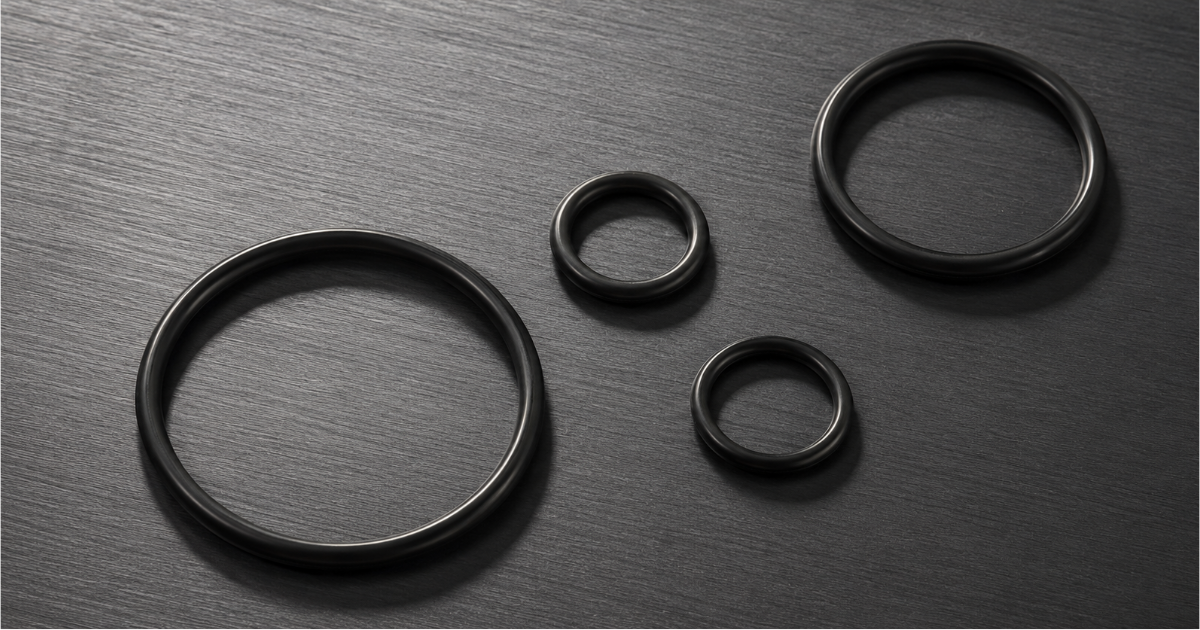
O-Rings continue to be the most widely utilized sealing product. While the ‘Donut’ shaped profile has by and large been kept intact since their inception, continued elastomeric development has pushed o-ring temperature and chemical compatibility to limits unimaginable several decades ago.
Typically, O-Rings fail due to adverse effects of a number of factors, from improper installation and lubrication to incorrect size and design. The collection of videos below will help you minimize installation errors that may lead to failure (be sure to bookmark this page for future reference).
How To Install an O-Ring - Standard Male Gland
[embed]https://youtu.be/QcJBVQvTvhw[/embed]
- November 16, 2017
[embed]https://www.youtube.com/watch?v=dAG0ymNGaHE[/embed]
Lubrication of O-rings is extremely important. The greatest benefit of using a lubricant is typically obtained during installation.
Using a lubricant is going to decrease the surface friction of the O-ring helping
- August 22, 2017
Article re-posted with permission from Parker Hannifin Sealing & Shielding Team.
Original content can be found on Parker’s Blog.
Solving Long Time Industry Problem
For several years, one of the biggest drawbacks of “chemically resistant” FFKMs, or perfluoroelastomers, has been their relatively poor compression set resistance. Typically, compounding these materials to be extremely resistant to many different chemical environments comes with the drawback of having to give up their ability to resist taking a set after being under high temperatures for an extended period. Parker's solution to this industry challenge is ULTRA FF156.
Best in class compression set resistance
Compression set refers to a common failure mode of elastomers where a seal permanently flattens out while in application and the joint begins to leak. A material's resistance to this permanent deformation can be easily tested in the lab. To do so, a seal’s thickness is measured, then that seal is compressed about 25% before being heated in an oven at a particular temperature for a predetermined amount of time. That seal is then removed from the oven and the thickness is remeasured.
- July 11, 2017
The face seal design chart below explains the hardware dimensions to use for an O-ring seal when the groove is cut into a flat surface.
Systems Which Contain Internal Pressure
For designing systems which contain internal pressure, like the example below, the groove's outside diameter (OD) is primary, and the groove's width then determines the inside diameter.
- June 20, 2017
Light-weight, robust polymer springs are replacing steel coil springs in a range of energy management applications including track tensioners for light-duty mobile equipment such as skid loaders.
With safety as Priority #1, use of polymer springs eliminates a potential source of injury and safeguards workers during equipment assembly and installation. Polymer springs are much safer to install compared to steel coil springs because their lowered stored energy reduces the risk of injury and damage due to uncontrolled release.
Product Features:
- Safer. Lower stored energy vs. steel coil spring reduces risk of uncontrolled release
- Smaller. For a given spring force, up to 75% reduction in space allows simple fixturing and assembly
- Lighter. Up to 90% reduction in weight for a given spring force gives equipment designers more degrees of freedom in weight distribution